Overview
Our goal is to provide crucial evidence that can underpin fishery management decision-making and policy development, as well as regulatory decision-making concerning developments such as marine renewables and major marine developments, including the abstraction for the new nuclear power station at Hinkley Point C.
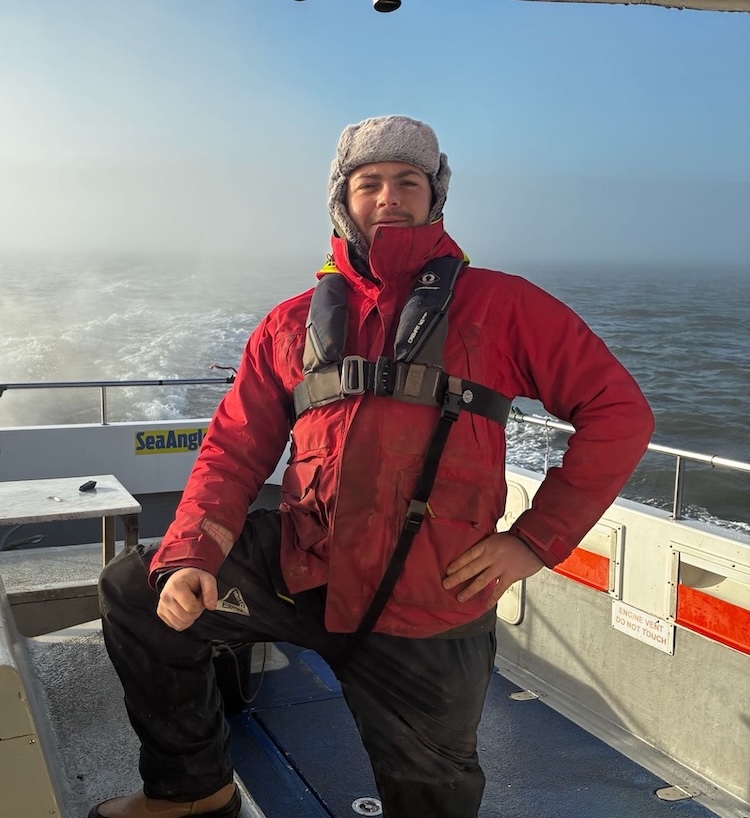
Since 2019 we have been using acoustic telemetry to study migration patterns, animal movement, depth use and survival in both freshwater and marine environment in the Bristol Channel and its tributaries, focusing on Atlantic salmon, sea trout, twaite shad, European seabass, rays (thornback, spotted, small-eye, blonde), European eel, tope shark and spurdog. Our database holds over 4 million detections of 1500+ tagged fish, collected with a long-term array of over 200 receivers deployed throughout the Bristol Channel and affluent rivers, and completed with morphological, capture and environmental data.
We also monitor cetacean presence and distribution in the Bristol Channel with passive acoustic devices (F-PODs); we conduct lab and in-situ acoustic experiments on fish behaviour to inform Acoustic Deterrent Devices development; we have conducted a genetic study on herring population structure and migrations in the South-West Approaches, and Celtic and Irish seas; we have led the CHART Cymru ‘Catch and release tuna tagging’ project in Wales in 2022 and 2023 for Welsh Government.
Check below for more info on the projects, our partners and our funders!