Social care involvement is often initiated from adverse, stressful or traumatic events experienced by children and young people, with abuse and neglect, parental illness, death, disability and other circumstances leading to social care referrals. Children known to social care represent an important and sometimes vulnerable population in the UK. In 2023, 17,513 children were known to social care – termed as Children Receiving Care and Support - which is equivalent to 283 children per 10,000 in Wales. There are three types of intervention:
1) Children with a social worker are those who remain with their families but receive support
2) Children on the protection register are those who remain with their families but are on a register which identifies the risk of significant harm
3) Children who are looked-after are those who are removed from their family and under local authority care.
The sections below highlight Dr Lowthian’s work in relation to:
1. The research on children known to social care’s educational outcomes – including non-technical reports, animations, and journal articles.
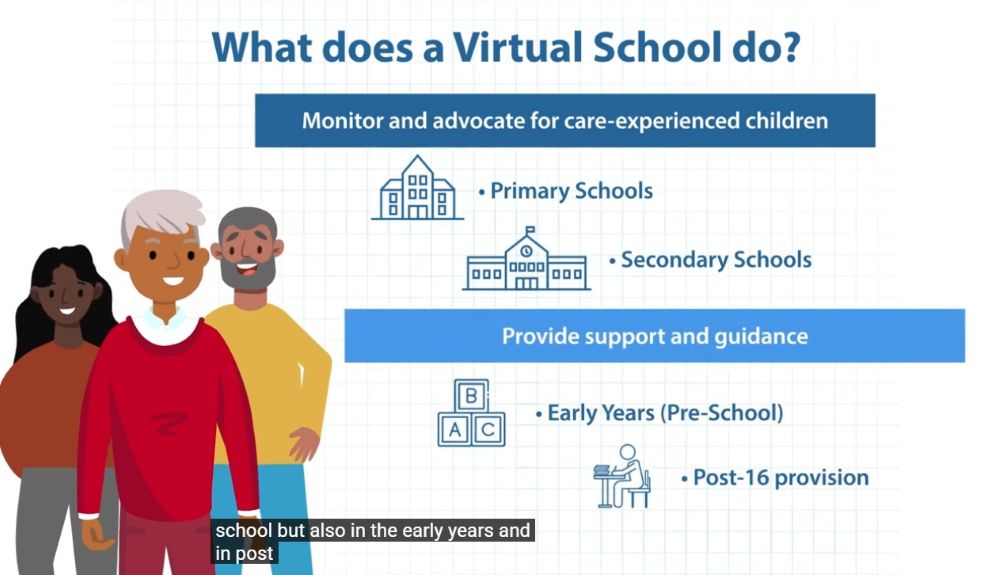
2. Impact work on the Welsh Virtual School Model; not to be confused with online learning, but where a senior lead in each local authority has responsibility for the education of children in care – an established practice in England and Scotland.
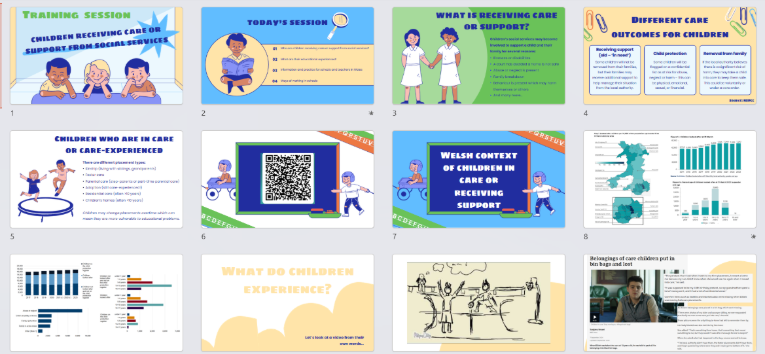
3. The development of a training programme for students undertaking Initial Teacher Education in England and Wales which focuses on the educational experiences of children known to social care.
Research on the Education of Children known to Social Care
Dr Lowthian has conducted significant research into understanding how social care can impact on educational outcomes including attainment, attendance, and school exclusion. Her two key studies are below, which include non-technical resources:
Research on the education of children known to social care:
In Lowthian et al. (2024), it was found that children in receipt of any form of social service intervention were more likely to not attain the expected level upon leaving statutory education at age 16, and all social care groups faced greater risk of emergency hospital admissions, compared to children in the general population, even after adjusting for adverse childhood experiences and other characteristics. The authors conclude that policy attention shouldn't focus solely on children in care but should extend to those identified as "in need" or "at risk" while remaining at home, with integrated support needed across health, education, and social care sectors.
For an animation on this research see: https://youtu.be/0kSKPhe5mfo?si=hm6Qh2_8rha64gXT
Research on care-experienced children’s educational progress:
Using national records data on education, school and social care data on over 1,000 children in Wales (2000–2019) Dr Lowthian and colleagues were able to map how movements in care relate to educational progress. They found that early-adopted children meet national expectations at age 7, whereas children entering foster care just before starting school record the lowest attainment. Educational progression declines over time with lower attainment at age 11 and 16 for all care-experienced groups. Many children had poorer school experiences including increased school moves, suspensions and exclusions, and household poverty. These aspects partially explained why children with short-term care lower attainment had, foregrounding the need for improved school support and multi-agency working approaches.
View the non-technical report
Educational attainment of care-experienced learner
A short animation explaining the research on care-experienced children's educational progress and attainment
The Virtual School Model in Wales
The Virtual School Model (VSM) isn't a physical school — it's a dedicated team that works alongside a care-experienced child's actual school to champion their education, working closely with social workers, carers, and others. The model has been used across England since 2014, where evidence links it to better attainment and fewer exclusions; Scotland also have a version since 2015. Wales piloted its own three-year version from 2021 to 2024, backed by Welsh Government funding, with participating local authorities trialling different ways of putting it into practice. An independent evaluation of the pilot, published in December 2025, found a range of positive impacts and recommended rolling out a statutory role across all Welsh local authorities.
Research and impact
Dr Emily Lowthian is conducting research into the Virtual School Model in Wales, aiming to understand what an effective model would look like for care-experienced children’s educational outcomes. After the release of the evaluation in 2025, she has co-written a blog on why Wales needs a new vision and strategy for care-experienced learners in Wales via BERA: https://www.bera.ac.uk/blog/why-wales-needs-a-national-strategy-for-care-experienced-learners.
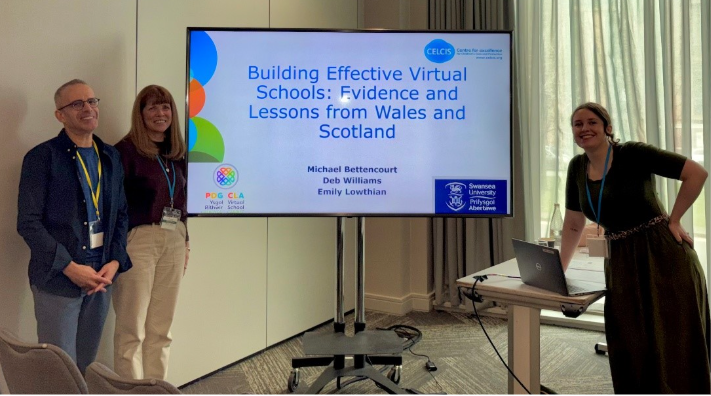
She has spoken at the National Association for Virtual School Headteachers in Birmingham in 2026 pictured with Michael Bettencourt (CELSIS) and Deborah Williams (Previous Virtual School Headteacher for Cardiff). This workshop focused on the progress so far of Scotland and Wales, and what they can learn from England – both the good and not so good!
She has been awarded £15,000 (ESRC IAA, 2026) to launch a Welsh event. This will include Virtual School Headteachers, Looked-after Children Co-ordinators, Practitioners and Policymakers to explore where the Welsh Virtual Model currently is, and to identify what Wales needs going forward to be more integrated in its support for care-experienced learners – this has arisen from her research.
A Welsh focus on the Virtual School Headteacher
A short animation explaining the Virtual School Model in Wales as of September 2026
Social Care and Initial Teacher Education
Dr Lowthian found that children known to social care have lower educational attainment, with 3 in 4 children in care having SEND, a third were suspended or excluded and 1 in 2 were economically disadvantaged. However, many children discuss school as potential place of belonging and normality. Social care is assumed to be rare, but it is estimated 1 in 4 children have a social worker at some point in England, and most classrooms will have a child in care. Many trainee teachers will teach children known to social care - but few have the tools to support them, despite being very motivated.
This tension provided an opportunity: How can we support the next generation of teachers to better support children known to social care?
Dr Lowthian transformed her research into practice by building a collaborative group of practitioners, carers and third-sector professionals. This led to a co-developed a pilot programme for students studying Initial Teacher Education (ITE) across England and Wales.
Outcomes from pilot training programme
The training reached over 400 ITE students from 12 organisations.
- 97% of students agreed that this training was important for trainee teachers
- Confidence moved from 5/10 to 7/10 - a 32% increase.
- Trainees reported that the training supported them to become trauma-aware, retain high aspirations, and place additional effort on developing a positive relationship with children known to social care.
After 6 - 12 weeks confidence sustained, and students explained how they had put the training into practice, and a few had re-delivered the training to their placement school.
The findings of the pilot training programme have been drafted into a policy report.
Next steps
Dr Lowthian has just secured a further £15,000 from the ESRC (2026) to scale up towards an e-Platform to reach more students through Innovation Lab Wales. The scaled-up e-Platform has the potential to reach 30,000 ITE students annually if providers embed it into their curriculum. The e-Platform will also improve by further collaboration and include case studies and reflective tasks. Most importantly, school support for children known to social care will improve - where aspirations are high and positive relationships are the norm.