Gareth Evans
Founder, Lumishore
MEng Electronic and Electrical Engineering
Class of 2000
What drew you to Swansea for your degree?
I've always loved Swansea. I'm originally from Swansea but grew up in Neath and wanted to come back to the “Big Smoke” as we called it. I was very much into surfing and the outdoors. When I started looking at university possibilities, I could see that Swansea had a good engineering department. I wanted to get into engineering, so it seemed to fit perfectly and still allowed me to enjoy all the outdoor activities that I had been brought up with.
I went to one of the Swansea University Open Days and I liked the fact that it seemed there were quite a few practical elements to the course. They had a really good lab facility that was run by Professor Tim Davis at the time. It was hands-on, real-world stuff, making PCB’s (Printed Circuit Boards) for whatever project you'd come up with right from scratch.
I moved to Hendrefoilan Student Village in the first year. That decision had nothing to do with the fact that my grandparents lived two minutes away so I could get help with laundry and get a Sunday dinner.
When you were at Swansea, did you have any particular projects or lecturers that stood out for you while you were there?
One name I've already mentioned is Professor Tim Davis. The other one that had a huge influence on what I ultimately ended up doing was Professor. Ken Board. But also, something that was very important was that during the first year, there was an opportunity for some students to apply to study overseas in America for their second year. I put my hand up. A classmate sat next to me also put his hand up. I was so surprised to see we were the only two that put our hands up, and ultimately, much to my mother’s dismay, we ended up going to Union College in upstate New York for our second year of study.
It was an eye opener for us. I think it's a slightly different way of teaching. We were tested at the end of each week on the content we had learned that week. I hated it at the time. However, I felt when we got back, we had a little bit of a headstart on our other classmates in terms of what we learned in that second year abroad. The constant testing meant things had stuck and I appreciated the lectures more as an opportunity to learn, rather than cramming for exams at the end of the year.
As well as all the cultural differences that come with it, the study abroad opportunity was a great experience. We speak a common language, but there are huge cultural differences between Britain and America. I think that experience helped me later in life, just how to deal with people, or being better prepared to deal with the American business culture.
Going back to Professor Ken Board. Ken, taught one module in year three, and at that point I decided to stay on and do my Masters. The 4th year, Masters courses were more about business enterprise and entrepreneurship, coming up with a business idea and how to write a business plan. Those were championed by Ken. I think he opened my eyes to the fact that as an engineer, you don't have to be put in one box of working for a company, you can go and do your own thing as well. Nobody had really explained that to me before. I'd always thought I'd end up working for big employers. At the time they were Vodafone or Orange, the telecoms companies were hoovering up graduates in our field. But having Ken say, well you could start your own company, your own thing, come up with an idea and evolve it into something. It was good to hear. He definitely encouraged me.
Things went further when there was a competition run by Ken Board. It was sponsored by another Swansea alumnus, Sir Terry Matthews. We had to come up with a business plan, and the winning plan would receive £1,000. I put a business plan together and came up with an idea and submitted that. The rumour is that I was the only person who submitted a plan, I’m not sure if that's true or not. I would say that makes me the winner, but I don’t recall ever receiving the £1,000. Ultimately, the true prize was for that idea to get passed onto the commercialisation department at the university. They took ideas and helped you develop those into a real business. We did go some way into doing that for a little while before we realised that the product idea may have had some IP issues.
I believe business development/planning should be taught much earlier - it was only the people staying on to do the master's courses that would have been exposed to that in my day. I recognised that I might want to start a company of my own one day, but I also recognised the importance of working within a company at least to learn a bit before you start on your own.
My initial step after graduation was to go and work for a few companies to get some ideas and see how they work before jumping and doing something for myself. My first job was for a computer company based in Basingstoke and that was a bit of a shock to the system, not least because of where it was. Having gone from Swansea with all the outdoors and surfing and everything, I realised I wasn't one for city or suburban living. And then, the shock of the nine to five as well, that is something that gets people after four years of study! But it was worthwhile all be it brain numbing. After a year-and-a-bit in Basingstoke, Ken actually called my parents to see what I was up to and if I wanted to come back to Swansea to be involved in a start-up that he was involved in. After an initial meet and breakfast chat at Verdie’s café, I jumped at the opportunity to come back and start building prototypes and be involved in a startup without taking any of the financial risk myself. It was quite exciting.
That was a company called Enfis. Enfis was brought to fruition based on trying to create LED lighting systems for medical use, for skin rejuvenation to replace lasers with the potential of having home treatment devices. You don't have the same kind of regulations around LED use as you would a laser. You can treat your own wrinkles or collagen stimulation from home rather than having to go to a specialised clinic.
That was probably my first real dalliance into LEDs. I knew what an LED was and how they worked and how to control them. But I had to do a lot of learning very quickly in those early months on LED technology, trying to find the best solutions for what we were trying to achieve. Enfis grew from being a medical only company to developing LED systems for a wide range of companies including Philips and Osram, from theatre lighting, television lighting, dental curing, etc. There were so many different things that Enfis were developing. Units for this and prototypes for that, and I was involved in all of those. But in the back of my mind, I always knew that I wanted to eventually do something for myself, I just didn’t know what.
At the same time as working for Enfis, I was also really into boats. I loved wakeboarding and water skiing or just messing around on the water with boats. And I thought with the LED being as efficient as it is, and with no breakable parts in there, it would also be perfect to work on a boat.
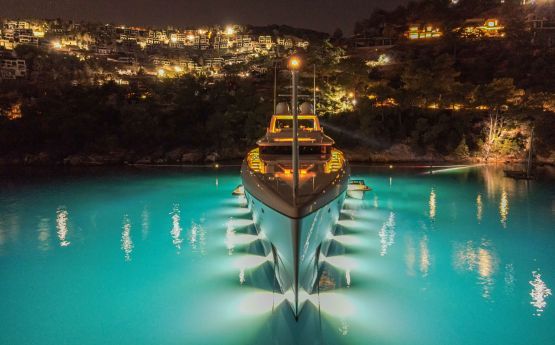
But I hadn't quite worked out what to do with it on a boat yet – what part of the boats lighting would most benefit from an LED and where were the gaps in the market. That idea came when I went on holiday to Greece. I had chartered a little boat with my girlfriend at the time, and we anchored in a cove; the sun was going down, and it was a beautiful evening. I remember it well. We had some friends with us as well, and we thought we were the bee's knees sitting on the back of the boat drinking a couple of beers... and then this other larger boat came in and dropped anchor, and they switched on some underwater lights. We all looked over and our jaws dropped. It was amazing because the lights created this huge swimming pool effect around the rear of the boat and everybody was jumping off the back of the boat and having a brilliant time in a swimming pool of light. I just thought “I've got to find out how they work”. I jumped off our boat and had a swim over to see how it worked. I knew straight away, that as good as it was, I could do much better than what I was looking at.
That was the light bulb moment for me, if you excuse the pun. I was perfect. LED's are absolutely suited for this because there's no parts to break. You've got long lifetime. They're more efficient to run than halogen technology, which I could see they were using. So, you wouldn't have to replace the bulbs every 100 or so hours. And of course, by using different wavelength LEDS you could also change the colours. All of the lighting on this boat we were looking at was just white only. I was an absolute nightmare for the rest of that holiday. I was just desperate to get back home and start Googling to see who's doing it or is anyone already doing it with LED technology and how much they sell for and all those kinds of things so I could start on a business plan.
What was the experience of the early days of taking the plunge and deciding to start your own business?
There are always positives and negatives but in the very early days, it was all about funding. How was I going to fund this? Pay for prototypes, marketing etc. I had a very understanding boss, Sean, and he knew that I wanted to start out on my own one day, so he was quite encouraging. He gave me a bit of guidance in the early stages but ultimately also helped me find my business partner, Eifrion Evans. Eifrion and I met and hit it off from the start, not least because he was a boat nut like me, but he could also see the potential of this idea. We agreed that with Eifrion’s years of commercial and sales experience he would look after those aspects leaving me to focus on the product ideas. It was a perfect match. With Eifrion also came a much-needed boost in cash flow to help start the business going.
In the early stages, when you're planning out how much you're going to need for prototypes, how much you're going to need for trade shows (which are incredibly expensive), how much you're going to need for patents, etc., you realise, gosh, this is going to cost quite a bit. I was in a fortunate position at the time where I didn't have a wife or family to feed, only myself to look after. So that did help because the risk was all on me. I knew that if it failed, I could go back and get employment again. I didn't have to. But things were very tight. We didn't pay ourselves very much at all really.
Was there a point when you felt that it was make or break, especially when the money was difficult to find?
Yeah, there were times, not just from the money side, but overcoming product development challenges . You think, oh my gosh, how are we going to solve this problem? If somebody challenges you with a problem or you need to do something if you're going to get into that market, you question yourself, is it worth this stress? Some of our very early prototypes were failing within a few weeks of being tested, and we couldn't work out why they were failing. The seal around the lens was not holding The lights were safe, but the electronics were getting wet, never a good thing! We didn’t want customers to have to call to say, “well, the boat's got to be lifted out of the water now, and who's paying for that?” Boats are expensive to lift out of the water. That's when you realise, you've got to call for some professional help. We ended up finding an adhesives expert in another university, who came down and helped us select a more appropriate adhesive and developed a process to use in the seals in our lenses. We’ve used that same adhesive now and process for 18 years. That adhesives expert became known to us as Gary the Glue.
There was another time when we had to get what's called Lloyd's type approval for the lights. This means that they give you certification to say your lights are safe to use. They told us we had to hit a far stricter EMC standard (Electrical Magnetic Interference Standards) than the previous standard that we thought we would have to achieve. And, by the way, they weren’t being applied across the board to our competitors. So, we were questioning why the highest standard was being applied to us and nobody else? We never really got an answer to that, but we decided to take it as a positive because we knew if we could achieve the standard that would be a selling point that puts us above the competition. We're the only ones to achieve that. Initially, it felt so unfair, we couldn’t see why we had to do it when our competitors didn’t have to. But, if we didn’t, it would have meant we wouldn't have been able to sell our lights into the super yacht world. So, we decided to go for it and get the lights to pass this higher standard and know that we're better than the competition.
Focus is the key to moving the business forward. That was one bit of advice I think that I learnt from Enfis. Enfis was a great company, but they were spread so thin across all of those sectors. If they'd focused on one thing, I think they would have been a real success. Each of the things they worked on has individually gone on to be a great success for other people. The temptation in the early days when you're developing something is already thinking about the next idea and so you can easily be swayed by friends or the new bright shiny thing. But if you can stay focused on your subject long enough to make that a success before going and branching off and doing other things, you’ll do well.
For us, it was underwater lights. People didn't really understand the need for underwater lights. There are some safety aspects, but generally it's bling to make the boats look good and add fun. Quite often people would say, why don't you do navigation lights, why don't you do searchlights or spotlights and they're all good things to get involved in. But we decided to make underwater lights. There was a good margin, there was good opportunity, and we were far from market leaders in the early days, but we stayed focused until we were market leaders and only then did we start looking at other areas of lighting onboard.
How does it feel now that you've sold the business to Garmin? Does it feel strange to take a step back from something that you've built and put so much of yourself into it?
It is a strange feeling but it's less stressful. That's the positive side of it. I was actually quite excited by the sale because in comparison we're a small team here in Swansea. I've had ideas in the back of my mind of how we could do things, or things I'd like to explore. Joining Garmin makes it more of a reality now that we've got this other big team of engineers and a large sales team that we can tap into, to help us develop things. It's strange that I'm no longer doing it for myself. I'm now doing it for other people within Garmin developing ideas. But what still excites me is still having the best product and being able to deliver something that nobody else is doing. That's something that we pride ourselves on. Always being the best and making ourselves a premium brand.
Do you think Garmin will start to look for new applications or will they stick with the original LEDs for boats?
I think there's huge market potential for different sectors. Garmin is very strong in the marine sector, but they also work within other markets. All the teams within Garmin are very excited that Garmin has acquired a lighting company. From our first week within Garmin, I had an email from a team, I can't tell you what they are developing, but it was something outside of our scope. That team had just discovered that Garmin had acquired a lighting company, and they got in touch with us for some help and it was really nice to be able to give that help as well.
Has there been a moment across the whole journey that stands out to you as a defining moment?
There are probably a few, but finding our first American dealer was a big moment. A company called SeaWide. They had gone to see our competitors. They'd actually come over to the Mets Trade Centre, which is a big trade show in Amsterdam. We had a small booth at the time. Our competitors, were the market leaders and they had a big fancy booth. I think the story goes that the owners had been out the night before and got so drunk that they didn't make the stand the next day and missed the meeting.
So, SeaWide came to us just out of curiosity because we are another underwater lighting company and they could very quickly see that, in their words, we were “offering a better mousetrap”. Basically, a better product than the competitors Anyway, they offered to take us out for out for dinner the next night and we discussed some more. That dinner, I remember, cost more than the car I was driving at the time. I was thinking, oh my god, I hope they are paying for it. And I remember looking at my business partner, and thinking, are we being taken for a ride here? When we were given the bill, he was sort of patting me down under the table going, “it's OK, don't worry. We can cover it.” But, you know, it worked out well because they quickly became our partners in America. We jointly owned Lumishore USA, so we managed to set up a sales and distribution office in Florida. It all went really well from there.
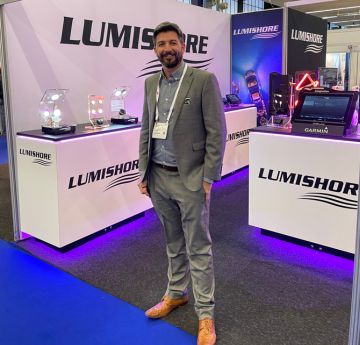
Another was also at the Mets Trade Show about four or five years later. There are two main halls at the Mets. There's lots of halls actually, but we've got the Leisure Marine Industry Hall, which is for boats up to a certain size and then you've got the Superyacht Hall, which is for boats costing 50, 100 million plus, lots of money! We decided one year to go and explore being in the superyacht hall to see what that was going to be like. So, we moved our stand up one year to see if that made more sense. We were showing our products, which were all designed for leisure marine boats, meant to be fitted into a hole drilled in the boat (usually a fibreglass boat) and sealed from the outside.
Anyway, we're on the stand and the first customer comes over and says, "Do you do any weld-in lights?” I said “no, I don't know what a weld-in light is”. Then later that day we have another customer come over and say, do you do weld-in lights? So, I thought I need to start looking at what weld-in lights are. By the 4th customer, which is at the end of day one, I was saying, “yes, we do weld-in lights!”
I had been busy at the back of the booth researching what weld-in lights are. It’s really the same technology, but changing the housing to be welded into the hull. We had no clue. We were in the hall not knowing that we had the wrong product for the market. But by the end of the day, because we were so small, could research it, work out what would need to be changed, we could make that change quite quickly. We were knocking up the data sheet and trying to print stuff off to say what our weld-in light would look like. Then by the end of the show, day three, we'd had our first order. I was in a bit of a panic, I told my business partner Eifrion, you know, I'd rather do a bit more research on this before we take any orders. He said, "Ok, don't worry. They're keen, they want to place an order, but I’ll put a silly high number on it to make it too expensive".
Anyway, we received the order the next day, but the value was high enough for us to say, okay, drop everything, we’re going to make this work. So, we did. The Superyacht market is still a very strong market for us.
As a boat lover yourself, that must have been a fantastic experience being able to sell your innovation to superyachts, and then see pictures of them all around the world?
It is, but because superyacht owners tend to be very private people, we have to sign NDA’s. So, we don't get to talk about specific projects we’re working on. Some of the biggest superyachts in the world are fitted with our lights, built right here in Swansea. You can pick from the top five richest people that own a superyacht and know they're fitted with our lights.
What advice would you have for budding entrepreneurs about the pitfalls of starting your own business?
Things do go wrong. But you've got to go above and beyond to make sure you put them right; take responsibility. It's so easy to say it’s out of warranty or put your head in the sand. But if you go the other way and lean into the problem most of the time, you can make it a success. If people know that you're taking responsibility or that you appreciate that there's an issue to be solved, then that's all they want to know.
Staying focused is a lesson that I saw was missed in the early stages of my career and something that I decided to take upon myself with Lumishore. Stay very focused.
But there is something else actually: I think I recognised early on and that it's knowing your own limits. My expertise was about developing products and ideas. I also recognised that I didn't understand enough about commercials, sales, marketing and whilst I was trying to learn those things through books, you can only teach yourself so much. If you recognise that you don't have the skills in those areas, join up with someone who does.
There are so many aspects to a business. You don't have to be an expert in all of them. You just have to recognise you're not an expert in all of them and bring in help when you need it. Because if you don't, you won't survive, or you won't be doing as good a job as you could do.
Connect with us on Social Media