
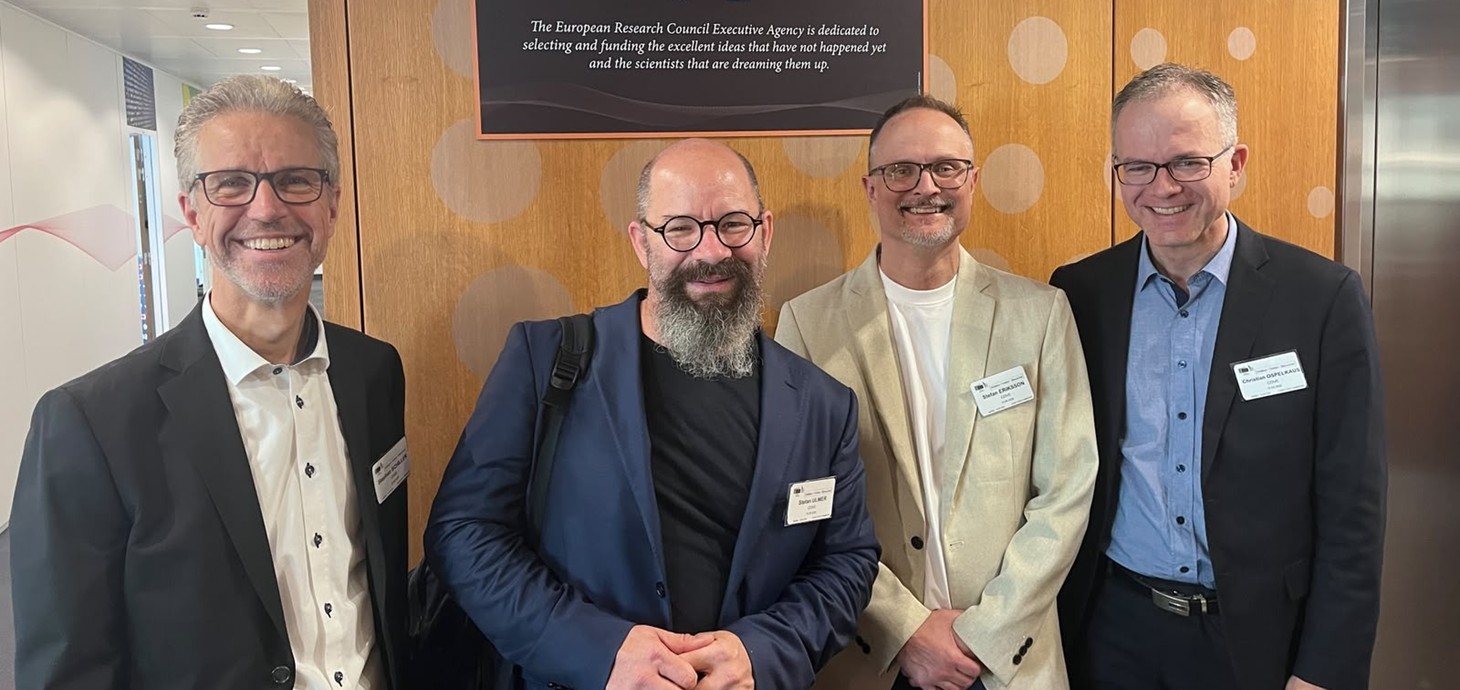
The EHPAS team (from left): Prof. Stephan Schiller Ph.D., Prof. Dr. Stefan Ulmer (both Heinrich Heine University, Düsseldorf), Prof. Dr. Stefan Eriksson (Swansea University, Wales) and Prof. Dr. Christian Ospelkaus (Leibniz University, Hannover) | Copyright: HHU/ Nicolas Stumpe
Swansea University physicists are part of an international research team awarded funding to investigate matter-antimatter symmetry.
The six-year project, funded by a European Research Council (ERC) Synergy Grant, brings together researchers from Swansea University, Heinrich Heine University Düsseldorf and Leibniz University Hannover.
The team aims to produce and study antihydrogen molecular ions for the first time, using highly precise laser measurements to look for tiny differences between matter and antimatter. Swansea University will receive approximately €4.2m (£3.5m) of the funding.
According to current scientific theory, matter and antimatter should behave almost identically, apart from having opposite electric charges and magnetic properties. When they meet, they annihilate, destroying each other.
Scientists believe the Big Bang should have produced equal amounts of matter and antimatter. However, the universe today is made almost entirely of matter suggesting that not all annihilated. How the observed asymmetry arose is not yet understood, and investigating the properties of antimatter may ultimately help resolve this major outstanding question.
Professor Stefan Eriksson from Swansea University's Department of Physics is leading the University's contribution to the project, titled Extending the Horizons of Precision Antimatter Spectroscopy (EHPAS).
He said: “The synthesis of a new species of antimatter, the antihydrogen molecular ion, will enable us to study antimatter in the highest detail to date so that we can determine if it behaves the same way as ordinary matter as expected. A discovery of even a tiny difference would require a ground-up revision of theory.”
The research will focus on antihydrogen molecular ions, which consist of two antiprotons and one positron. Studying these particles could allow scientists to make more precise comparisons between matter and antimatter than have previously been possible.
The first major challenge will be producing the antihydrogen molecular ions. This work will be led by Swansea University researchers at CERN in Geneva, currently the only facility in the world where such experiments can be carried out.
Swansea researchers are already involved in the ALPHA collaboration at CERN, which has successfully produced and trapped antihydrogen atoms to allow detailed study. Producing and safely storing the new molecular ions will be a significant next step.
Professor Eriksson said: “Making antimatter molecular ions requires the most advanced synthesis techniques, and even then, the production rate is initially likely to be so low that many trials will be needed before we can conduct precision measurements. This is why it is so important that we capture every single anti-molecule, store it safely, and ensure that none are lost during the experiments.”
Once produced, the ions will be transported to specialist laboratories in Düsseldorf in a part of the project led by Professors Stefan Ulmer and Stephan Schiller for detailed measurements. Researchers will use lasers to examine their properties and compare the results with equivalent measurements of ordinary matter.
The team will also draw on expertise from Professor Christian Ospelkaus's group at Leibniz University Hannover, which will contribute advanced measurement techniques to help achieve the precision needed.
The project aims to complete its comparative measurements by 2032. Its findings could help scientists establish whether matter and antimatter behave differently and bring them closer to understanding why matter came to dominate the universe.