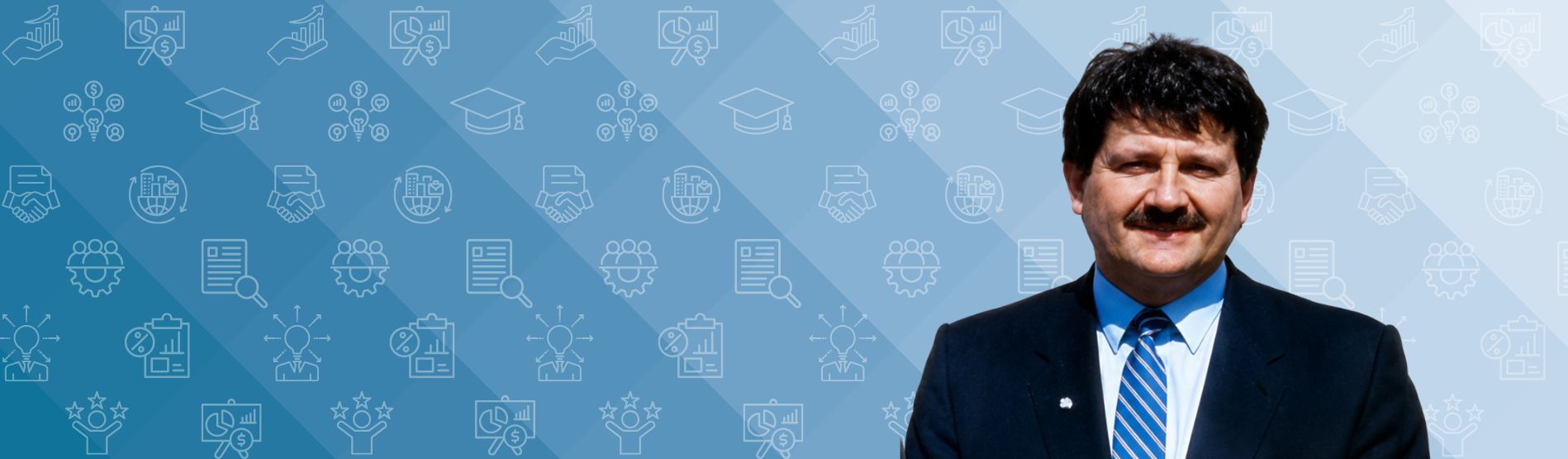
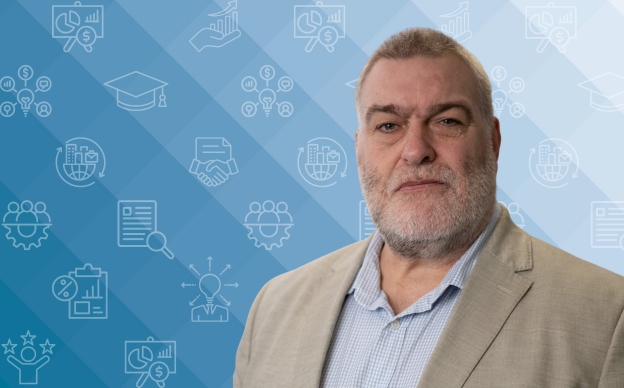
Gwyn Brooks
Mechanical Engineering BSc. 1965, MSc. 1966, PhD. 1970
Founding Member of Osprey Metals Ltd (now Sandvik Osprey)
For someone who doesn’t have much insight into your industry, how would you explain what you invented and how the business evolved?
Basically, there are only a few ways of making shaped components in metals and alloys. The oldest of these is casting. There is a whole range of casting processes, which have been around for thousands of years. However, castings are relatively weak because the cast metal cools slowly in the casting mould and the resulting, segregated microstructure is coarse, so if you drop a casting, it will often crack because of its inherent weakness. To get over this problem, it was discovered that if a large metal casting (in the form of an ingot or a billet - i.e. a large diameter bar) was produced, and this was then heated and beaten, literally with huge hammers, then a “wrought product” was manufactured. In such a product the internal microstructure is broken down and made finer. The finer the microstructure, the more uniform it is, and the properties are improved. Wrought products are needed in a huge range of highly stressed applications, such as structural beams, girders, bolts, pipes and tubing, drive shafts for turbines, flanges, gears, etc.
In about the 1920s, the idea of using metal powders to manufacture small, complex shaped components was conceived; i.e. Powder Metallurgy (PM), but it was not until the 1940s that PM developments were rapidly advanced for mass commercialisation. PM is a precision manufacturing process that creates metal components by blending, compacting and sintering metal powders. This, typically, involves metal powder production, mixing/blending the powders and then compacting them into a complex-shaped die, followed by sintering (i.e. heating to below the melting point of the metal powders) to form high-strength, near-net-shape components. The virtue of a powder process is that each particle, or atomised droplet, contains its own microstructure. Consequently, you don’t get what is called a ‘segregated’ microstructure: for example, when casting iron-based alloys, that contain nickel, chrome, etc. as the alloying elements, these elements don’t disperse very well and try to stick together. This segregated microstructure would result in poor properties in the finished product. Such segregated microstructures are avoided in PM products which have a fine, uniform structure free from segregation. Consequently, PM is widely used for producing relatively small, complex, high quality, parts for use in automotives (gears, etc.), aerospace components, tools, etc. Metal powders can be produced by a variety of methods (depending on the end – use applications): notably, crushing, grinding, chemically, water and gas atomisation, etc.
In January 1969, I started as the Leader of the Spray-Rolling Project at the Dept. of Metallurgy in Swansea University, which included Alan Leatham – a brilliant, innovative metallurgist who, based on his work during the Project, later obtained his Ph.D. Jeff Coombs, another graduate from Swansea University’s Mechanical Engineering Department joined the project team a few months later. Jeff is an extremely practical, resourceful and inventive engineer. Without realising it then, we had the essential technical spine and founding members of Osprey in place.
This stainless-steel device had a series of small, concentric holes drilled in it, through which we injected high pressure nitrogen gas, so that supersonic jets of gas would impinge onto the stream of molten metal, break it up to create a fine spray of metal droplets which consisted of a great number of rapidly cooling, segregation-free droplets of metal alloy. This spray would then be directed onto a rotating drum to create a strip of solidified metal alloy which, hopefully, we could then roll directly. It was almost like instant powder metallurgy. That was the objective of the Spray-Rolling Project. However, after a year or so, we realised that it wouldn’t be viable because we could not then produce a sprayed deposit that was uniformly thick across its width. When we tried to roll it, it would crack and break up.
During 1971, the Project (funded by the National Research and Development Council) was coming to an end, so we had to think about the future. At about this time, the three of us, Alan, Jeff and myself, had a meeting over a couple of beers, in the Rhyddings pub. Alan said “I have an idea - what if we sprayed into a mould to produce a shaped, hot preform, which could then be immediately forged into its final shape in one forging step”? In such a case, the stresses within the preform are predominantly compressive, rather than tensile (as in rolling), thus enabling the preform to be fully consolidated without cracking. Such a method offered the unique possibility to drastically shorten the manufacturing process from molten alloy to a finished forging in seconds, compared to weeks, or even, months when using the lengthy, conventional route. I said, “Where the hell did you get that idea?” and Alan replied, “In the bath last night”. We all got excited, we knew it would be a bit more complicated than that, but we thought it could work.
Anyway, that was the original concept of what became the Osprey Process which, at the time, we thought could be used to manufacture large quantities of relatively small, engineering components, such as gears, flanges, cutting picks, conn-rods, turbine blades, etc.
I wrote the first patent, to which we all contributed. It cost me £75 - my wife was furious: this was 1971 and she said, “We could go on holiday for that!”
For many years, I had a good friend (Gerald Davies - we played cricket together at Neath Cricket Club) whose family had quite a reasonable sized business in Neath, producing refractory-based products, mainly for local steel companies. Gerald considered himself to be an entrepreneur and he was very interested in Osprey’s technology. Consequently, he persuaded his family to “invest” in us, and eventually the Davies family became one of its shareholders. The other shareholders were the Inventors (i.e. me, Alan and Jeff) and a Scottish millionaire, for whom I was working as Managing Director in his chemical business, based in Port Talbot.
Formation and Growth: The Sandvik Connection
So, we set up a very crude workshop in Neath and started experimental work. We published papers, we went to relevant conferences, and we continued to carry out developments. It was a very unusual arrangement. We had two basic sponsors - one provided us with a workshop, secretarial facilities, electricity, telephones, fax, etc. and the other, the Scottish millionaire, paid some of the salaries and other expenses - that’s how we got started. We formed a company which was Osprey Metals Ltd.
We carried out lots of small development contracts for companies all over the world, who were interested in the Osprey Process. They all came to downtown Neath! It was quite amazing to see all these companies from all around the world - Japan, China, the USA, and Europe - in Neath. We made a very wide range of spray-formed products in many complex alloys, for our customers to evaluate. We generated a reasonable income stream, not much, but enough to keep us alive. Eventually, it became clear that the process was not best suited for manufacturing relatively small components, because the spray cone was quite large and there was always a lot of over–spray that would be collected at the bottom of the spray-chamber as powder. We realised that, for economic reasons, the process was not going to be viable for the manufacture of small, forged components, due to low process yields.
Then, in 1977, we had a visit from Lars Ljungstroem, a senior engineer from Sandvik Steel AB, Sweden - who became a great friend. Sandvik made a lot of tools, such as chisels, saws, etc, but at the time of Lars’s visit I didn’t realise that they also manufactured many other steel-based products. I said to him “Lars, I don’t think this process is going to be suitable for making chisels and hammers.” He then replied, “Gwyn, I’m not interested in those, I want to make big tubes.” It was like a light bulb moment! I said, “Lars, we’ve never made a tube, but we’ll make a tube tomorrow”, and we did. We made a spray-formed tube in a special stainless steel and they were delighted. They thought it was terrific. We used a tubular, sand crucible as the substrate and we rotated it and passed it through the spray by hand. A high proportion of the metal spray was deposited on the substrate, and we built a tube with a wonderful microstructure - they loved it. We then did a lot of development work for Sandvik, and in early 1979 they asked to buy a worldwide, exclusive licence for the manufacture of tubes for use in gas, oil and petrochemical applications. So that was our first big licence!
I can’t remember what the up-front licence fee was, but I think it was in the region of £200k which, at the time, was huge for us. That was one of the key moments for the business; we then had lots of world-class metal processing companies coming to us, and eventually we sold over 30 licences worldwide.
Later in 1979 Sandvik acquired a controlling interest in Osprey (after a dramatic last-minute intervention), they provided much-needed stability and financial support, which was a great relief to Alan, Jeff and me. A few years later, the name of the company was changed to Sandvik Osprey.
We then started to think that the process would be much more suitable for manufacturing large, semi-finished products, such as large diameter tubes and solid, round billets which would have a fine, uniform, segregation-free microstructure, for use in a wide range of highly stressed components.
The US Navy and Global Licensing
We also got involved with the US Navy. Together with Sandvik, we worked with the US Navy for several years. They wanted large diameter tubes in a very special stainless steel for use in nuclear submarines. It was top secret at the time, as it was during the Cold War. The Americans decided that they were going to build 16 nuclear submarines, each costing about $6 billion. Each submarine was to be fitted with eight tubes, a metre in diameter and about 3.5 m long. These were the tubes through which they would fire nuclear missiles if they had to. We sold a licence for $10 million up-front, a significant deal in the early 1980s. Alongside Mannesman Demag, we built a plant to manufacture the tubes, but with Gorbachev and Reagan ending the Cold War, everything changed. They came to a non-proliferation treaty under which the US Navy decided that they would only build two such submarines. Consequently, the contract came to an end.
Over the next 20 years or so, we sold many licences worldwide, receiving up-front payments for the transfer of technical know-how and royalties on the manufacture and sale of products. Selling technology licences for the Osprey Process was a really great adventure, Alan and I travelled all over the world. One of the first licences we sold was in early 1979, to a British company based in Swindon (Deloro-Stellite, which was part of the BOC group of companies) the licence was not for the Osprey Process, but for the production of gas-atomised metal powders. In 1977, we did some work for Deloro, producing spray-formed extrusion dies in cobalt-based alloys. We sent them to Deloro, but we also sent them some of the overspray powder because we knew that they used a lot of such alloy powders. They liked the dies, but they were really impressed with the powders. Cobalt-based powders are used for hard-facing applications, in which the powders are deposited onto the work-piece with spray-guns. Based on the results, Deloro asked us to produce powders for them on a regular basis.
This opportunity led us to build our first spray-chamber specifically designed for the production of gas-atomised metal powders. This was the start of Osprey’s powders production business, which eventually became big business for Osprey. We also sold licences to Deloro and to their new US owners (the Cabot Corporation). In the next few years, we sold a further 15 licences worldwide whilst, at the same time, we were also selling powders directly to a range of different customers. At this time, Osprey’s Powder Group manager was Dr. Roger Dunstan, another B.Sc./Ph.D. from Swansea University’s Metallurgical Department, who was well known to us from our time together at university.
Evolution into Super-fine, Gas-Atomised, Metal Powders and CE Alloy Products
In 1986, Dr. Bob Howells (a close of mine for many years and a B.Sc./Ph.D. from the Department of Mechanical Engineering at Swansea University) joined Osprey as Powders Group Director. Soon afterwards, we thought that we could make a more successful business by producing and selling gas-atomised metal powders, rather than through licencing. So, we stopped licencing powders technology and concentrated on the manufacture and sale of powders. At about this time, Drs. Howells and Dunstan made a major break-through in the development of atomising technology that resulted in greatly increasing the yield of super-fine powders. We decided not to patent this technology because it could lead to other companies copying it.
As the spray-forming patents neared expiry, we knew that licensing income would start to fall off. So, by about 2000, it was decided that Osprey would use its spray-forming technology to manufacture and sell a range of unique products, based on Si/Al alloys, which we termed Controlled Expansion Alloys (CE Alloys). These alloys are machinable, lightweight, have a low coefficient of expansion, and high thermal and electrical conductivities. They were developed by Osprey (with Dr. Andrew Ogilvy as a lead investigator), in conjunction with GEC Marconi. The first significant supply contract (valued at £2.2 M) was achieved with Lucent Technologies, USA.
In addition to the manufacture and sale of CE Alloy products, Sandvik Osprey produces gas-atomised powders for a huge range of applications, including Metal Injection Moulding (MIM) and Additive Manufacturing. As a result, the company is now the number one provider of gas-atomised powders in the World, with over 2000 alloy variations - and we are still based in Neath!
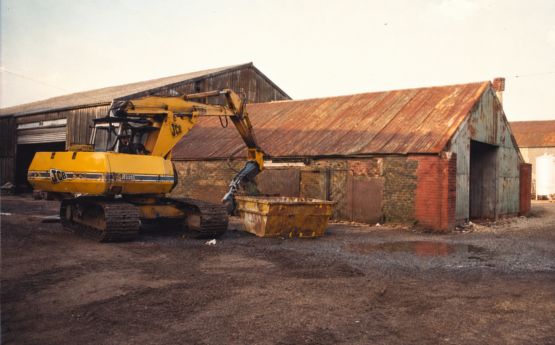
The company now employs around 180 people and Sandvik has made significant investments in the site at which we started the business. From humble beginnings, in a dilapidated, 300 years old, stone building, which had a leaking corrugated roof and no heating – the company has grown into a global leader, thanks largely to Sandvik’s support. Sandvik is a most honourable company, with very high moral and business ethics, and has been a wonderfully supportive parent company.
What are some of your best experiences running the business?
Going back to late 1970s, we were visited by Howard Hilderbrand (an American ex-military man). He was a hell of a character who had set up a business in Switzerland, which involved the use of precious metals. In particular, he was buying gold and silver powders for jewellery applications. He came to Neath in a private plane and landed at Swansea airport. When he arrived at Osprey, he had a steel box handcuffed to his wrist. In the box were three ingots of a gold alloy weighing one kilogramme each (they were then worth about £20k each, but in today’s money that’s about £120k each). He wanted us to produce powder to see if it was suitable for his business purposes, in which case he would want to buy a production licence from us. We hadn’t sprayed gold before, and I was praying that there were no leaks in the spray chamber, otherwise our yard and the men’s toilet would be covered in very expensive gold powder! Fortunately, all went well and we eventually signed a licence agreement in late 1979.
In 1990, we went to Russia and we stayed in a smart, modern hotel (The Mezh) which was built with American money for the 1980 Olympic Games. At the end of the week, we invited everyone to dinner at the hotel. It was very smart, the waiters were in tailcoats. There were ten of us, including a young KGB officer. There was a bottle of vodka for each diner, and liberal quantities of Russian champagne and caviar were served - it was a great night, and there were toasts and hugs all round from the Russians. We were paying, and we weren’t earning a lot of money at the time, so Alan and I were dreading the bill. Anyway, when it came, Alan asked me how much it was. I replied “you’re not going to believe this, it’s in Roubles, but it works out to be £44 for the ten of us!” We both agreed that we should each have had another bottle of vodka!
You and the other founding members of Osprey all studied at Swansea together. How important was your experience at Swansea for shaping the rest of your journey?
It was absolutely vital. I mean, there’s no question about it. Two of the founding members were from the Department of Mechanical Engineering. That’s me and Jeff Coombs. I was an industrial entrant, and I was the first member of my greatly extended family who went to university. I never really thought about going to university; I wanted to follow my elder brother as a design engineer in what was then the Steel Company on Wales (SCOW). After “O” levels at Neath Boys Grammar School, I got a job at SCOW as an apprentice draughtsman for three years. I did well in my ONC and HNC (Ordinary and Higher National Certificate) exams and I was awarded a Technical State Scholarship, but I was not sure what to do with it. Mr. Bradley (a nice man), the Training Officer at SCOW, said to me, “Gwyn, you’ve got to go to university.” Looking back now, it was transformational advice for me. So, I went to Swansea as an industrial entrant. I did Mechanical Engineering and got a first. Then my professor said “you should do some research” so, I did a Master’s degree and then a PhD. I had just finished when the professor of metallurgy (Professor Singer) asked my professor if he could recommend an engineer to lead a team for his spray-rolling project. Singer said to him that he wanted a mechanical engineer because nothing works without them. So, I joined the Department of Metallurgy as team leader of the spray-rolling project. Then, after about nine months, we decided we needed a design engineer. So, I got Jeff to join us. Then there was Alan, he was the metallurgist. Alan and I are still great friends and we’ve been everywhere together. He lives in Bishopston, so Swansea was the vital link.
Later, two other outstanding graduates from Swansea University joined Osprey – Dr. Bob Howells (Mech. Eng.) and Dr. Roger Dunstan (Metallurgy). They were responsible for making Osprey’s powder business such a success. So, five ex-students from Swansea University have been the driving force that created Osprey.
Was there a defining moment, when you realised you had made it?
Actually, yes! It was signing the licence agreement with Sandvik. Of the original partners in Osprey, the Scottish millionaire turned out to be a very difficult man to work with. He liked to control everything, and because we were operating from a site in Neath, which he didn’t control, he was not very pleased. In fact, we ended up in court after Sandvik had acquired a controlling interest in Osprey. He’d already threatened the company by saying that we owed him for his funding investment, which was ridiculous, because he had a third shareholding in the company in exchange for such funding. At the same time, the other sponsor (the Davies family) was having serious financial difficulties. They were told by their bank manager to sell their shares in Osprey, and a deal was agreed to sell the company one week later to a Sheffield-based company. We, the three inventors, would have been employees, but nothing else. We had shares, but they were minority shares in the company and would not have been of real value, especially in the event of any further funding that would be required.
As they were a licencee, I had to tell Sandvik, so I called my friend Lars Ljungstroem, to tell him what was happening. I also told him that the Scottish investor had made a claim against us, and it was a hell of a mess. Then he said words that I will never forget: “Gwyn, do not sell, we will have men in London on Monday morning with money in their pockets.”
True to their word, they came to a Heathrow hotel on Monday morning, and we were there with our lawyers. They asked us and the Davies family what we would want for our shares. There was a little bit of haggling but eventually we settled on a deal that we were all happy with. So, we went into London to their lawyers in Bloomsbury Square and we sat down to do the deal. You could not have written a script to describe the timings of the previous few days - we went from agony to ecstasy in about 3 days!
What advice would you give someone who’s thinking about starting their own business?
I’ve been asked this question a few times and it’s difficult to give a really definitive answer, but I think if you believe in what you’re doing, then you’ve got to be tenacious. You don’t get any prizes for coming second in business. You know, there would have been times it would have been easier to pack in and go somewhere else. But you’ve got to believe in what you’re doing, you’ve got to stick at it - be persistent!
Reflecting on his journey from an apprentice draughtsman to a founder of Sandvik Osprey, Gwyn points back to his alma mater. “It would not have happened if we had not been at Swansea University. If it hadn’t been for Swansea, I’d be doing something ordinary somewhere else.” One of the best decisions of my life was to go to Swansea University.
Later, two other outstanding graduates from Swansea University joined Osprey – Dr. Bob Howells (Mech. Eng.) and Dr. Roger Dunstan (Metallurgy). They were largely responsible for making Osprey’s powder business such a success! So, five ex-students of Swansea University have been the driving force that created Osprey.