
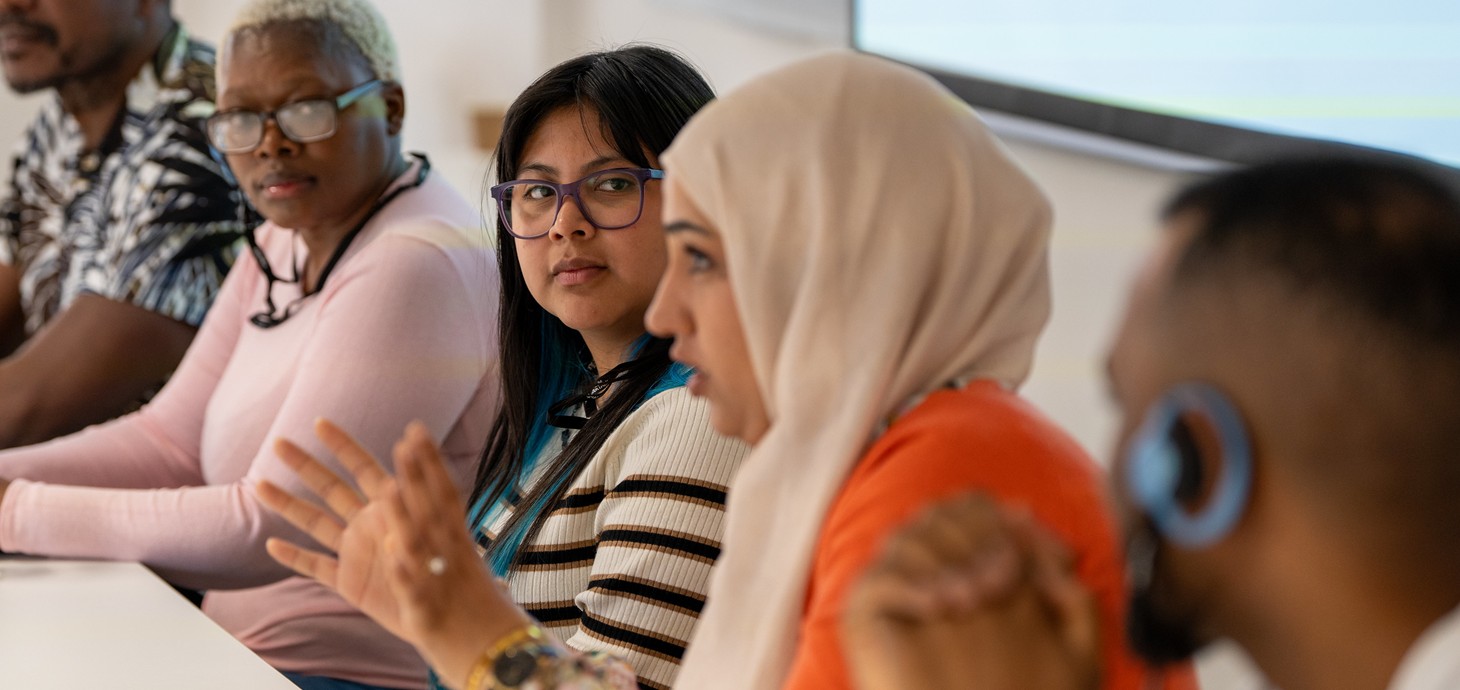
WSOL learners participating in a panel discussion at the WSOL consultation event.
A Swansea University academic is part of a new project exploring how language education for refugees and migrants can become more multilingual and inclusive across the UK’s devolved nations.
Dr Gwennan Higham, Senior Lecturer in Swansea University’s Department of Welsh, is part of the Multilingual, Decolonial Approach to Adult Refugee and Migrant Language Education (MDLE) Project, led by the Open University.
Funded by the Economic and Social Research Council (ESRC), the project brings together 13 partner organisations across Scotland, Wales and Northern Ireland to develop an approach to language education that incorporates indigenous minority languages, refugees’ and migrants’ home languages, and English.
The project is led by Dr Sarah Cox, Research Fellow at the Open University (OU) in Scotland, alongside OU co-lead Dr Sylvia Warnecke, Professor Mike Chick (University of South Wales) and Dr Mel Engman (Queen’s University Belfast). Dr Memory Malibha-Stratton, an OU Research and Innovation Associate, is also part of the team.
The research draws on the team’s experience of both refugee and migrant language education and indigenous language education across the three nations. It will also build on innovative work undertaken in Wales over recent years to develop Welsh for Speakers of Other Languages (WSOL) provision and explore how minority language learning can support the integration of refugees and migrants.
The project also builds on consultation events held in Belfast, Cardiff and Edinburgh in 2024 with stakeholders including third-sector organisations, local authorities, further education colleges and people from refugee and migrant backgrounds.
The research will take place in three phases. Researchers will begin by interviewing key stakeholders in each nation before using their findings to co-design workshops and teaching resources with partner organisations.
These activities will inform an open-access online professional development course for language teachers, which will remain available through OpenLearn Create after the project ends. The final phase will bring stakeholders from the three nations together through knowledge exchange events to share findings and build relationships. As part of the project, stakeholders from Scotland and Northern Ireland will visit Wales to observe examples of multilingual and minority language provision in practice and to exchange learning with Welsh organisations.
Dr Sarah Cox, Project Lead, said: “By increasing learning between the devolved UK nations, we hope to shift attitudes and practices in language education, increase teachers’ skills, knowledge and confidence in multilingual, decolonial approaches, and strengthen networks between English for Speakers of Other Languages (ESOL), teachers, indigenous language experts, and refugee and migrant communities. The work taking place in Wales around WSOL and integration has been particularly influential in shaping discussions of the project.”
The project will work with organisations involved in ESOL and indigenous languages across Scotland, Wales and Northern Ireland, with the aim of influencing policy and practice and improving the experiences and wellbeing of refugees and migrants.
Dr Gwennan Higham said: "Recent developments in Welsh for Speakers of Other Languages have demonstrated the potential of minority language learning to support integration, participation and belonging. This project creates an exciting opportunity to share learning from Wales while collaborating with partners across Scotland and Northern Ireland to develop more multilingual and inclusive approaches to language education.”