
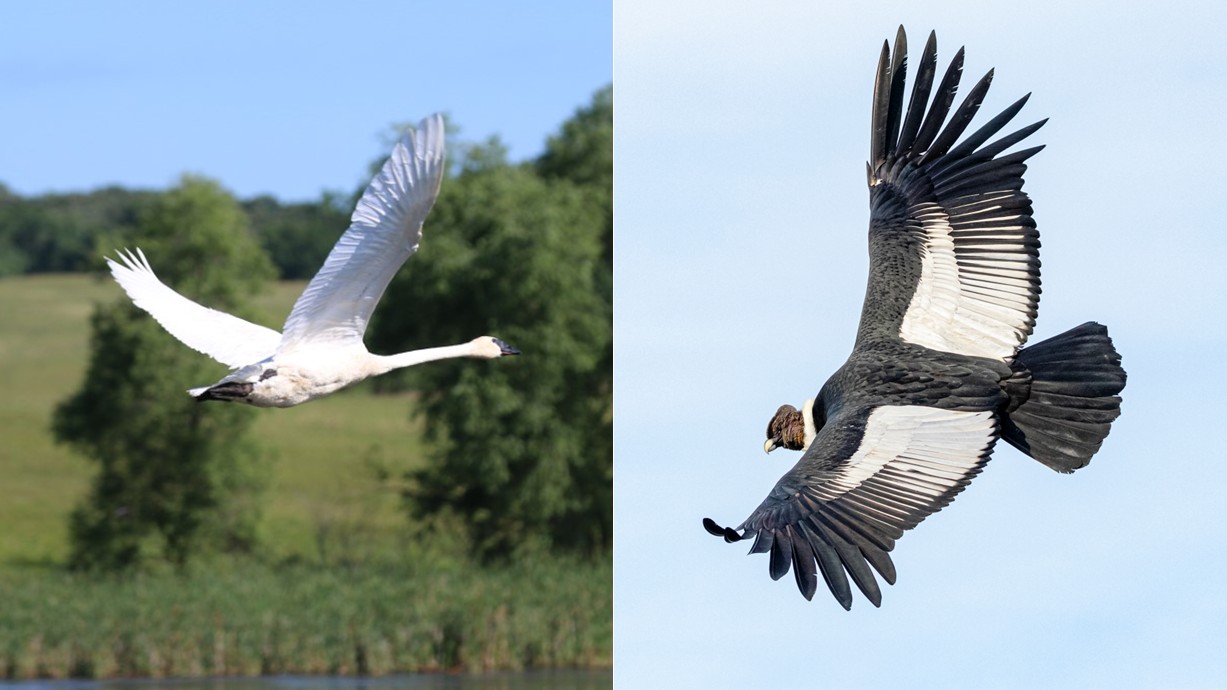
The trumpeter swan (left) and the Andean condor (right) are among the world’s heaviest flying birds. Despite their similar masses, the energy required to travel a given distance differs dramatically between the two species. Credit: Brett Blocker (Left) | Alvaro Moya Riffo (Right).
A major international study involving Swansea University has overturned a longstanding textbook view of how much energy animals use to travel, revealing that flying can sometimes be cheaper than swimming.
An Andean condor and a trumpeter swan both weigh around 11kg. Yet the condor can cover each kilometre of flight using a fifth of the energy the swan needs.
The difference is how they use the air around them. Condors can ride rising currents, flapping for just 0.1% of their flight time, while swans flap for around 99%.
Dr Martina Scacco, first author from the Max Planck Institute of Animal Behavior (MPI-AB), said: “To us, the sky might just look like background for flying animals, but it is an essential resource that can dramatically change the cost of a journey.”
Published in Science, the study was led by MPI-AB with Swansea University, and supported by an international team of researchers.
Swansea University’s Professor Emily Shepard, senior author of the study, said: “The laboratory rules tell us that condors and swans must have the same energy bill because they have the same body mass. Yet seeing how condors soar and swans flap, we know that clearly there must be a difference.”
Textbooks have traditionally ranked swimming as the cheapest form of animal travel, followed by flying and running. But these comparisons largely rely on laboratory measurements that do not account for the winds and rising air animals encounter and use in the wild.
The study brought together 17 years of GPS and accelerometer tracking from 850 birds and bats across 38 species, with four years of radar data covering 12 size classes of smaller flying animals. Researchers used the data to distinguish high-cost flapping from low-cost soaring and examined how wind and rising air affected the energy needed to travel.
This allowed the scientists to compare fuel economy across species, like comparing the freight costs of sea mail and air mail.
Professor Shepard said: “When flying animals have access to natural atmospheric flows, they have free fuel from the sky. Soaring birds use this to move at costs that are cheaper than swimming.”
Among soaring birds, heavier species generally flapped less and had lower costs. Seven vulture species travelled more than 4.3 million kilometres, enough to circle the planet more than 100 times, while flapping for just 0.1% to 7% of their flight time.
However, this energy saving comes with a trade-off. Larger soaring birds were more restricted in when and where they could fly, while flapping species could cope with more variable conditions at a greater energetic cost.
As well as challenging long-held assumptions about the cost of animal travel, the findings could help researchers understand how changing climate conditions may affect where and when animals travel in the future.
Dr Kamran Safi, senior author from MPI-AB, said: “If atmospheric conditions change, so too will the cost of flight, and therefore how animals decide to migrate and establish communities.”
Read the paper in full: Airflows redefine the cost of aerial transport in the wild