
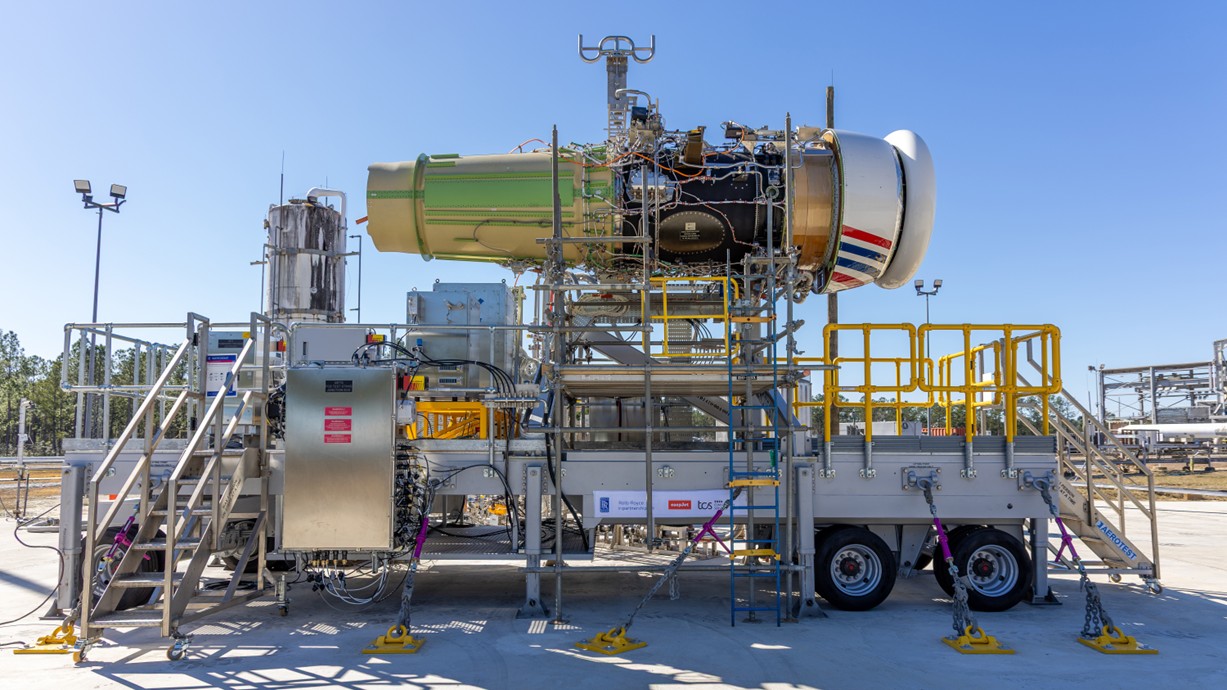
A modified Pearl 15 engine. Credit: © Rolls-Royce plc 2026 • All rights reserved.
Researchers from Swansea University are celebrating their role in a major aviation milestone, following the successful completion of a four‑year, international programme led by Rolls‑Royce and easyJet to demonstrate hydrogen as a viable aviation fuel.
The programme has culminated in a world-first achievement: a modern aero engine running on 100% hydrogen at full take-off power, proving the potential of hydrogen to play a transformative role in future zero-carbon aviation.
Swansea University provided critical materials data to support the development of hydrogen-fuelled gas turbines as a core partner in the UKRI-funded HYEST (Hydrogen Engine System Technologies) initiative.
As part of the project, Swansea’s Institute of Structural Materials (ISM) established new world-class mechanical testing capabilities in two areas previously unexplored by the research group:
- Cryogenic temperatures
- High‑pressure hydrogen environments
These facilities were developed through close collaboration between the ISM and the University’s Steel and Metals Institute (SAMI).
The new capabilities allow researchers to replicate the extreme conditions hydrogen-fuelled engines must withstand, generating essential data for safe and efficient engine design.
Professor Mark Whittaker, Director of the Institute of Structural Materials (ISM) and the Rolls‑Royce University Technology Centre (UTC) in Materials at Swansea University, said: “ISM is an internationally recognised research centre specialising in mechanical testing in high‑temperature environments. SAMI brought complementary expertise in working with challenging industrial gases such as hydrogen, enabling us to create truly unique facilities. These have generated extensive data to support the development of hydrogen‑based gas turbines.
“Our close relationship with Rolls‑Royce has created an environment where laboratory‑scale mechanical characterisation can directly inform how materials behave in a hydrogen‑fuelled engine.”
The Swansea team’s contribution forms a vital part of the broader industry effort to accelerate the transition to zero‑carbon aviation technologies.
Louise Gale, Materials Specialist at Rolls-Royce, said: “The testing programme at NASA Stennis represents the culmination of a comprehensive, global program that set out to prove that hydrogen can safely and efficiently deliver power for aerospace engines. The Rolls-Royce programme followed an incremental, technology-led approach to prove the fundamental technologies, including materials.
“Swansea was a clear choice as a partner for the HYEST programme, building on our strong relationship developed through many successful previous collaborations on materials testing and characterisation. The development of hydrogen-fuelled engines requires novel materials test capability to validate material behaviour in hydrogen environments. The test capability developed by Swansea has allowed us to generate key materials data to support component design and safety assessments.”
Learn more about the School of Engineering and Applied Sciences.