
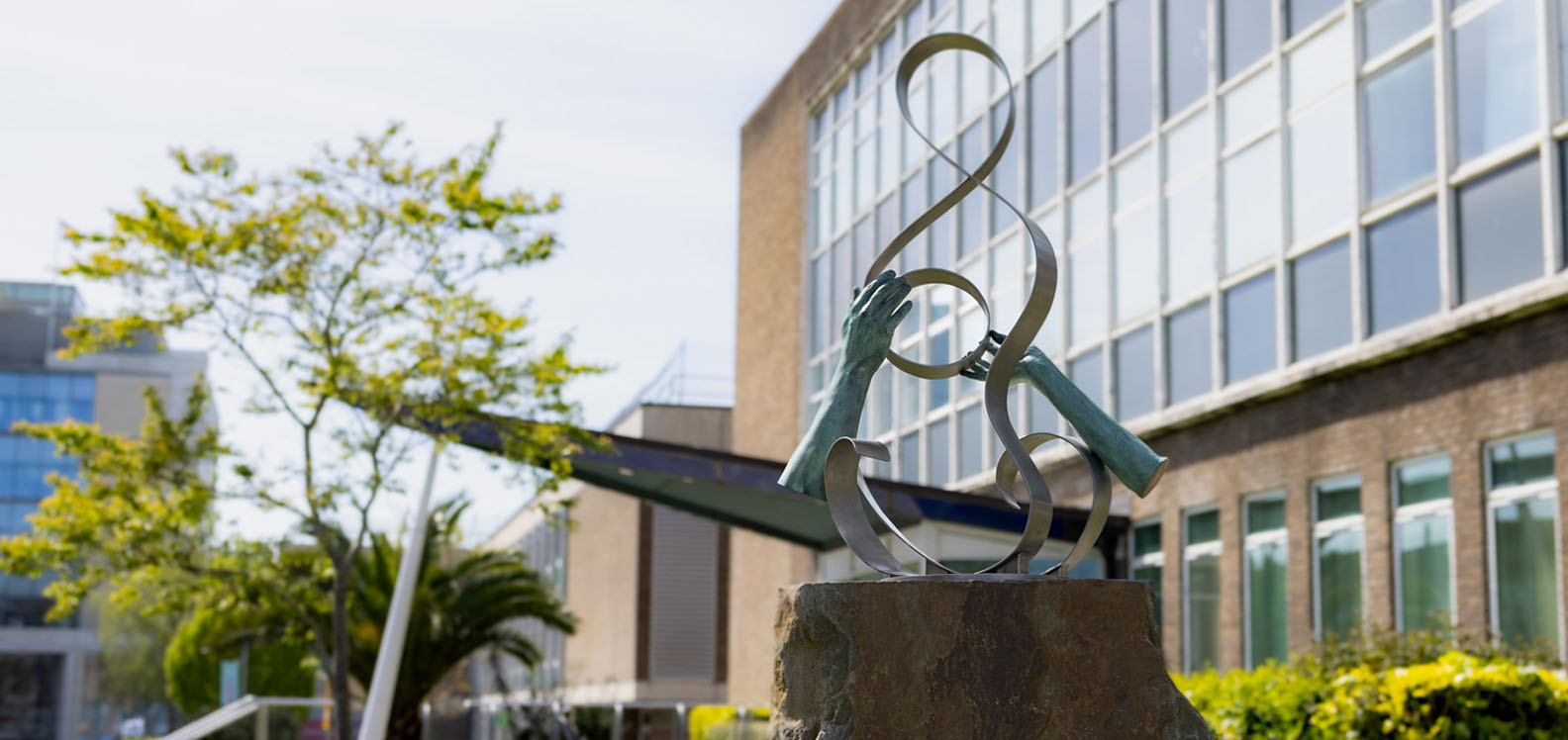
The Body Donor Memorial Project sculpture in situ outside the Grove Building.
A permanent memorial sculpture has been unveiled at Swansea University’s Singleton Park campus to recognise the invaluable contributions of individuals who donate their bodies to medical education and research.
Their generosity provides an extraordinary resource for hands-on learning, giving medical students and healthcare professionals a deeper understanding of human anatomy and the complexities of disease.
Swansea University makes extensive use of donated human tissue for anatomy teaching, not only for medical students, but across a wide range of programmes, including Neuroscience, Applied Medical Science, Psychology, Medical Pharmacy, and Osteopathy.
The sculpture is the culmination of a three-year initiative, The Body Donor Memorial Project, led by Dr Marcela Bezdickova, Associate Professor in Anatomy at Swansea University Medical School. The project was supported by medical students, who launched a dedicated fundraiser to support the creation of this lasting tribute.
Dr Bezdickova said: “Body donors provide our students with invaluable exposure to real human anatomy – the very material they will work with in their future professions. Often referred to as their ‘first patients’ or ‘silent teachers,’ they remain the gold standard for anatomical education, offering a level of detail and individuality that synthetic models simply cannot replicate.
“Our students benefit so enormously from this generosity that we felt strongly there should be a permanent way to commemorate them. We hope this beautifully striking memorial honours their remarkable gift and offers a dedicated space for reflection on the profound impact they have on future generations of healthcare professionals.”
Located in front of the Grove Building, home to the university's anatomy laboratories, the six-foot sculpture stands on a Pennant stone base. It was created by prominent Carmarthenshire-based sculptor Lee Odishow, widely recognised for his design of the Welsh Dragon Memorial in Flanders.
The design centres around a stainless-steel ribbon representing the donors. Interlocking loops within the ribbon symbolize the head and the heart, humanizing the tribute while moving away from a literal anatomical representation.
Cast in bronze and finished in a traditional vert de gris green, the forearms that cradle the heart represent both the magnanimity of the donor and the gratitude felt by students and researchers. Notably, the sculpture features both feminine and masculine arms, intentionally challenging the historical ‘male-default’ representation in medical education.
Hope Vaughan-Hughes, a second year Graduate Entry Medicine Programme student, said: "Learning and gaining experience from our donors is a privilege that stays with us forever. This sculpture finally gives us a place to thank the people who gave so much to our education before we even met our first living patients.”
Dr Bezdickova added: “On behalf of The Body Donor Memorial Project, I would like to extend our deepest thanks to everyone who contributed to our fundraising effort; it is because of their generosity that we now have this beautiful permanent space for reflection."