
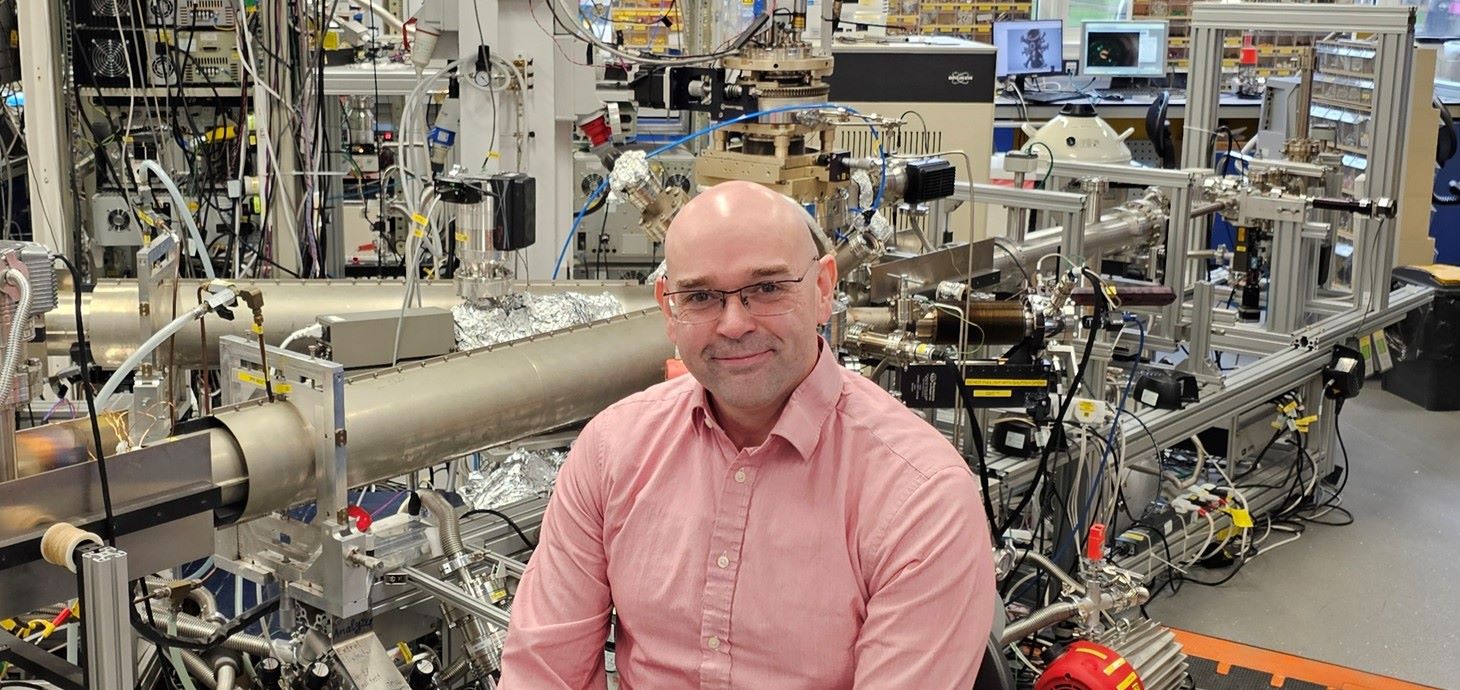
A Swansea University scientist has been awarded almost £1m to lead a new research team investigating antimatter gravity.
Dr Christopher Baker, from the School of Engineering and Applied Sciences, was selected by the Leverhulme Trust to receive a prestigious Research Leadership Award which is given to talented early career scholars who need to build a team to help them tackle a distinctive research problem.
The scheme aims to create an opportunity for them to demonstrate leadership by supporting the career development and the project management of their group, enabling research that may significantly change the established landscape in a particular field of inquiry.
As they are awarded only once every three years, this is among one of the Trust’s most exclusive programmes and selection is widely recognised as a marker of outstanding research excellence and leadership potential.
Dr Baker has been awarded £952,434 which will now be used for staff salaries and associated costs for his project to explore the transformative use of hydrogen spin echo to study antimatter gravity.
He said: “Our understanding of the universe is incomplete, and new physics is needed to explain why it looks as it does. Swansea University is a major supporter of fundamental research and I have previously studied an elusive substance called antimatter.
“Any differences between it and the ‘normal’ matter which makes up our everyday world would point towards the new physics. These tests are typically done by probing the antimatter atoms with lasers, but recent studies have begun to look at how the antimatter atoms are affected by Earth’s gravity, and this needs a completely different toolkit.
“As a member of Swansea’s Surface Dynamics Laboratory I am currently innovating methods to control molecules at the quantum level and study very subtle phenomena at material surfaces.
“My Leverhulme Research Leadership Award will allow me to extend this research, combine the two scientific fields, and lay the groundwork for developing a completely new approach to study antimatter and gravity in an innovative new way.”
Learn more about School of Engineering and Applied Sciences