
Animal Behaviour: Touchdown: How do seabirds reduce flight risks close to the ground? (RS1006)
Closing date: 2 December 2026
Key Information
Open to: UK and international applicants
Funding Providers: BBSRC SWBio
Subject Area: Animal behaviour
Project Start Dates: October 2027
** (Please see the note below regarding potential later start dates.)
**In exceptional circumstances, and subject to the discretion of the University and/or the relevant funding body, a deferral of offer may be granted to the next available enrolment period. Such deferral will typically not exceed a duration of three calendar months from the originally stipulated commencement date. Please note that only one deferral may be considered, and any such deferral is not guaranteed.
Supervisors:
- Dr Shane Windsor (University of Bristol)
- Prof. Emily Shepard (Swansea University)
- Prof. Arthur Richards (University of Bristol)
- Prof. Rory Wilson (Swansea University)
Mode of study: Full time or Part time
Place of study:
- Swansea University (Singleton Campus)
- Other: University of Bristol
Project description:
In many animals, breeding colonies resemble "animal cities", where individuals congregate year after year to reproduce, exchange information and benefit from collective protection. For flying animals, colonies are also airports. Birds must repeatedly take off and land in challenging environmental conditions and crowded airspace. In aviation, the risks of operating close to ground are well established: airflows (i.e. crosswinds, gustiness and wind shear) can compromise flight control, which can result in accidents and fatalities. These risks also affect birds. Recent studies have revealed regular crash-related mortality in colonies of gannets and albatrosses. The number of crashes depends on the wind, and the fatalities are frequent enough to affect population growth rates. This raises fundamental questions about how birds perceive and manage risk when flying close to ground, and whether landing safety has influenced colony structure and location.
This interdisciplinary project will use high-frequency biologging data to investigate how seabirds mitigate landing risks in variable wind conditions. The student will have access to exceptional existing tagging data and be able to undertake further targeted tagging with national and/ or international project partners to develop two core objectives:
(1) Identify the conditions that cause high-impact landings, as a measurable proxy for flight risk. Peak landing impact will be estimated from onboard acceleration data and modelled in relation to wind in northern gannets (using acceleration data from the Bass rock, recorded at ≤ 200 Hz), with the potential to expand the approach to other cliff-nesting taxa (≥6 species of auk and albatross).
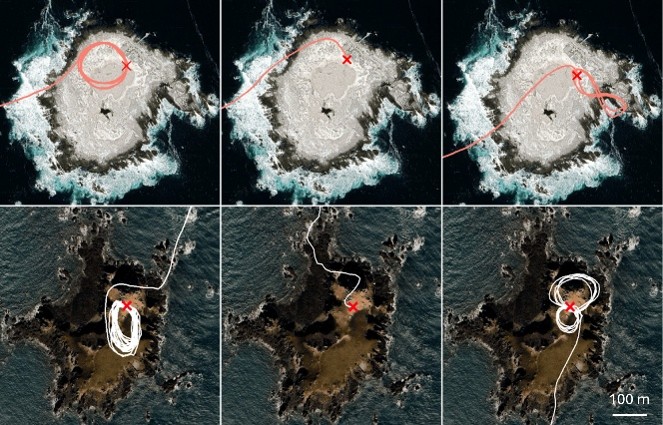
(2) Investigate how birds adjust their pre-landing decisions, including their approach trajectories and number of landing attempts, in relation to wind (figure 1). Analyses will draw on behavioural ecology and aerodynamics, testing whether birds and human pilots use analogous landing rules, while also exploring whether birds use pre-landing movements to transfer information (e.g. on their foraging success). High-frequency GPS data are available for four closely related species (northern and cape gannets, blue footed and Peruvian boobies) that together span a two-fold range in body mass (~1.4 kg - 3.0 kg).
Together, this project will provide new insight into the wind conditions that are most challenging for birds, how these vary with body mass and flight style, and the generality of the behaviours that have evolved to maintain flight control.
Eligibility
Note for international and European applicants:
Details of how your qualification compares to the published academic entry requirements can be found on our Country Specific Entry Requirements page.
If you have any questions regarding your academic or fee eligibility based on the above, please email pgrscholarships@swansea.ac.uk with the web-link to the scholarship(s) you are interested in.
Please note that the programme requires some applicants to hold ATAS clearance, further details on ATAS scheme eligibility are available on the UK Government website.
ATAS clearance IS NOT required to be held as part of the scholarship application process. Successful award winners (as appropriate) are provided with details as to how to apply for ATAS clearance in tandem with a scholarship course offer.
Funding
This scholarship covers the full cost of tuition fees and an annual stipend at UKRI rate
(£21,805 for 2026/27) - October 2026 onwards
Additional research expenses of up to £4,000 per year will also be available.
How to Apply
To apply, please complete the entire application form here:
Please apply to Bristol University: https://www.swbio.ac.uk/agriculture-environmental-projects/
Informal enquiries are welcome; please contact:
NAME: Emily Shepard
EMAIL: e.l.c.shepard@swansea.ac.uk
NAME: Shane Windsor
EMAIL: Shane.Windsor@bristol.ac.uk