
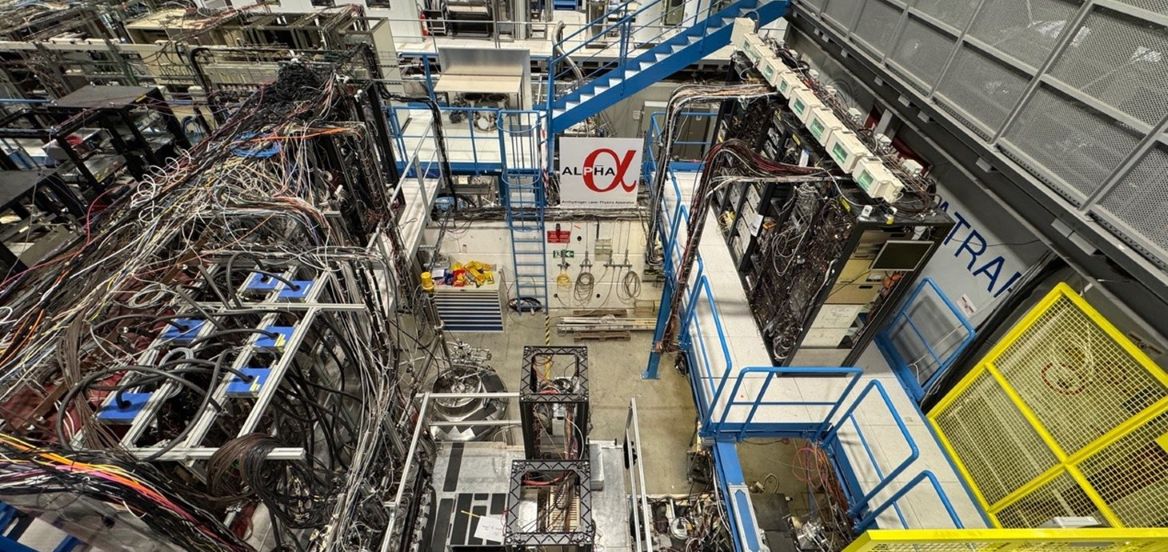
Swansea University physicists, as leading members of the ALPHA antihydrogen collaboration at CERN, have determined the ground state hyperfine splitting of antihydrogen 100 times more accurately than ever before.
The measurement breaks new ground on the knowledge of the internal structure of antihydrogen, the elusive antimatter counterpart of hydrogen. Hydrogen is the most abundant atom in the Universe, but antihydrogen, which is purported to be its mirror image, must be synthesised in the laboratory.
Why there seems to be almost no antimatter in the universe remains a conundrum and improved knowledge of antimatter, in this case the unique antihydrogen system, may help explain this.
The research has just been published in Nature.
A key factor in the breakthrough was a novel technique pioneered by the Swansea team that uses laser-cooled Beryllium ions to sympathetically cool the antielectrons (called positrons), which are one of the two types of particles that make up antihydrogen.
Antihydrogen is made by merging antiprotons provided by CERN with these cold positrons and the new technique allowed a massive increase in numbers produced and trapped. The experiment is performed on trapped antihydrogen which allows long interaction times, and this new technique allowed the present experiment to be carried out with more than 25,000 trapped antihydrogen atoms, the most ever used for an experiment. This significant increase in number, was a major factor in the ability to complete this precise measurement.
Professor Niels Madsen, from Swansea University’s Department of Physics, said: “With the new measurement, and spectroscopy of the 1S-2S transition (ground to first excited state) - another effort led by Swansea - it is expected to soon be possible to observe the finer details in antihydrogen that, for hydrogen, played a key role in the development of quantum mechanics, the theory at the basis of most modern physics.
“Finer details may ultimately reveal a difference between hydrogen and antihydrogen that could cast light on the apparent near absence of antimatter in the Universe.”
Find out more about physics research at Swansea