
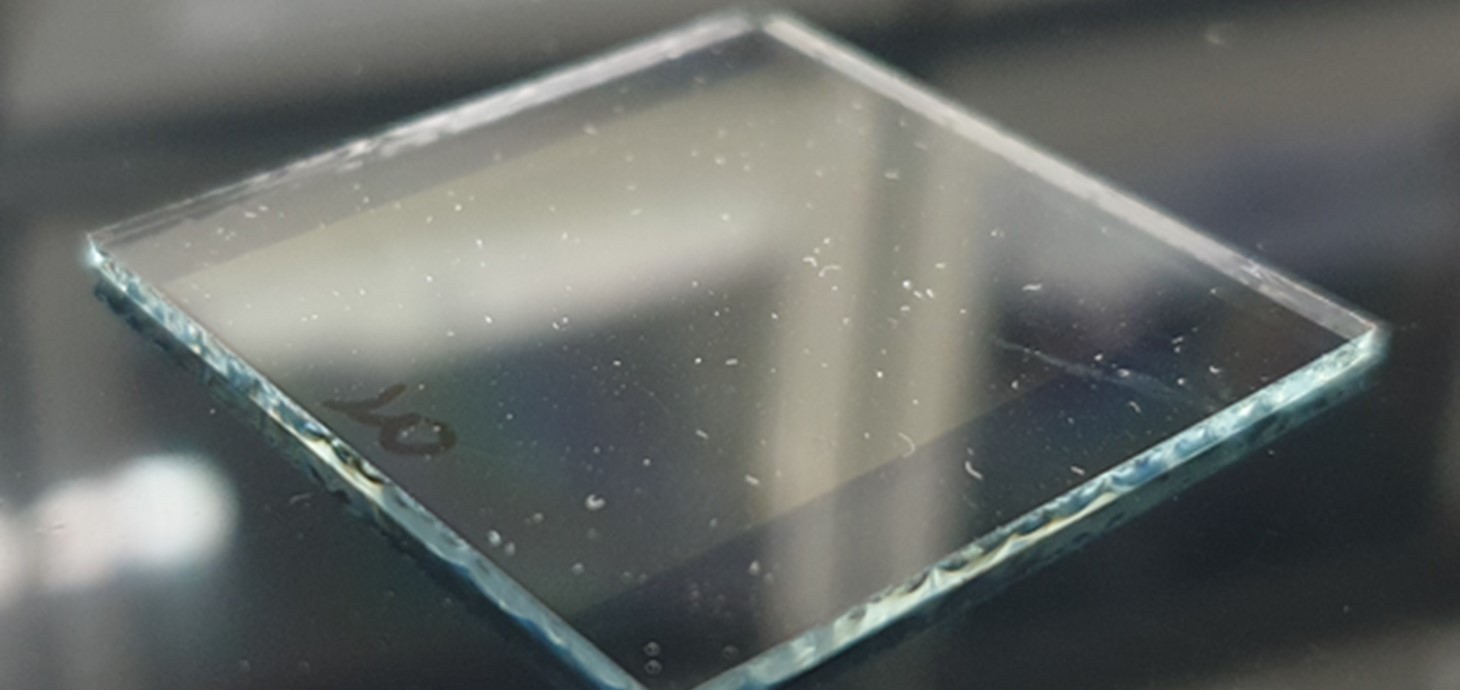
A partially made planar perovskite solar cell with dust deposited.
New research has shown that perovskite solar cells (PSCs) are remarkably resilient to dust during production, challenging the industry belief that high-performance solar technology must be manufactured in sterile and expensive "cleanrooms”.
This discovery could reduce the need for ultra-clean factories, making solar cell production cheaper and more accessible worldwide.
PSCs are a new type of technology that uses a unique crystal structure to harvest light. They are thinner, lighter, and potentially much cheaper to produce than the traditional silicon panels found on roofs today. However, traditional silicon cells are incredibly fragile during the making process; even a single microscopic dust particle can ruin a cell. This forces manufacturers to use expensive, energy-hungry cleanrooms, creating a massive barrier for production in developing nations.
Researchers at Swansea University’s Faculty of Science & Engineering have now found that perovskite technology has a unique tolerance to common dust and debris. Lead author of the study, Kat Lacey, explains: “To test the limits of the technology, we designed a custom ‘dust box’ to simulate various environments, from standard laboratories to dusty corridors. We used industry-standard test dust to see how these foreign particles impacted the devices during production.”
The team tested both standard laboratory solar cells and a scalable "roll-to-roll" version designed for mass production. They systematically introduced dust at different stages of the process, simulating a device sitting in an unprotected room for several days.
The results revealed that:
- Despite being covered in microscopic dust, the solar cells performed almost identically to those made in sterile cleanrooms.
- The perovskite crystals simply grew around and over the dust particles without significantly impacting the device’s ability to generate current.
- Contamination did not cause the cells to degrade any faster than other mechanisms, even when exposed to high heat and humidity.
"Our findings are a major win for the future of affordable green energy," said Kat Lacey. "For a long time, we believed high-quality perovskite solar cells had to be made in expensive, ultra-sterile environments. However, our research shows that these cells are surprisingly resilient – they can still perform remarkably well even when exposed to common dust.
“By providing quantified evidence that we can manufacture effective solar cells outside of a controlled lab, it opens the door to much cheaper production. This is a game-changer for bringing low-cost renewable energy to parts of the world where expensive facilities simply aren't an option. While there is still a need to test how this holds up on a larger, industrial scale, these results are a massive first step. We’ve shown that the path to a sustainable future might be a lot less complicated, and a lot less expensive, than we previously thought."
Read 'Manufacturing planar perovskite solar cells in dusty environments' in Communications Materials.