
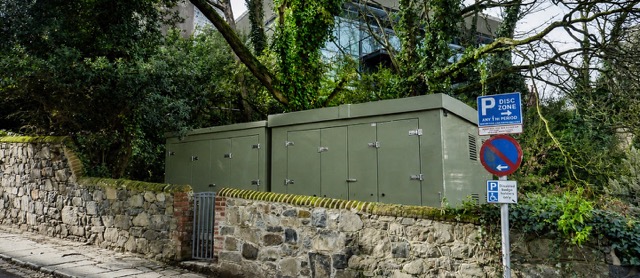
Building the evidence base for low-carbon fiberglass infrastructure
We're pleased to announce ARCS and Quinshield, a Carmarthenshire based manufacturing company, have successfully secured funding to run a full lifecycle assessment (LCA) of Glass Reinforced Polyester (GRP or fibreglass) buildings. Funded through the Place Based Impact Accelerator Account: Switch Net Zero Building Swansea (PBIAA: SNZB) programme, the project builds on our earlier collaboration with Quinshield and extends it into a comprehensive whole-life environmental assessment the assesses the impact from material sourcing, through use and end-of-life.
The problem we're solving
GRP composite enclosures are used extensively across UK water, utilities and infrastructure sectors for their durability, corrosion resistance and low maintenance. These qualities that keep products in service for decades, but can make them difficult to process at end-of-life.
Durability sits at the heart of a longstanding tension in circular economy and sustainability thinking. Design something to last longer, and you reduce how often it needs replacing and the material throughput that comes with that. Design it for easy disassembly and recyclability (or to be compostable), and you may trade away some of that longevity. Trade-offs like these are common in circular design practice – striking the correct balance depends on a comprehensive understanding the materials and the context around how the product will be used.
Life Cycle Analysis (LCA) can be an important tool to help evaluate these design choices and enable data-led decision making by allowing us to model and compare different scenarios. However, LCA’s are only as good as the data they are based on – and for GRP, these comparisons have historically been made on incomplete information. So, what happens when you don't have robust data?
Most of the environmental evidence used in procurement and design decisions focuses on the manufacturing stage, the emissions embedded in producing a material or product. Use-stage data, covering how a product actually performs over years or decades of service, is much harder to come by. This isn't unique to GRP, a lack of robust use-stage and end-of-life data is a persistent gap across many industries, making whole-life comparisons difficult. As companies come under growing pressure to prove their carbon credentials, these data gaps become a real problem, with decisions at design, purchase and disposal being made with only half the picture.
That's very much the case for GRP. A lack of up-to-date, whole-life data means many procurement frameworks still rely on embodied carbon figures sourced from a 1997 study, overstating the true environmental impact of GRP systems and disadvantaging South West Wales manufacturers in tendering processes. Our earlier scoping work with Quinshield found this figure to be 225% higher than conservative estimates based on current operations and materials, a gap that can matter enormously before questions of durability or recyclability are even weighed up.
What we're doing about it
This project will work across Quinshield's supply chain to build the whole-life data that's currently missing, undertaking a cradle-to-grave LCA of representative GRP buildings covering raw material extraction, manufacturing, transport, installation, use, maintenance and end-of-life. By capturing what happens during use and end-of-life we aim to close the information gap that currently makes it hard to make well-informed decisions about GRP structures.
We'll identify impact "hotspots" and reduction opportunities, produce an independently verified environmental dataset aligned with EN15804 and c-PCR-029 for use in Environmental Product Declarations and procurement frameworks, and develop a transferable impact calculator that other GRP manufacturers in the Swansea Bay City Region cluster can adopt.
The Swansea Bay City Region hosts one of the UK's largest concentration of hand-lay GRP composite enclosure manufacturers, supporting an estimated 2,000 direct and indirect jobs. This project stands to strengthen the competitiveness of the whole cluster and support more accurate, evidence-based decarbonisation decisions across the supply chain.
Get in touch
We're keen to hear from other GRP and composite manufacturers in the Swansea Bay City Region cluster, as well as procurement teams, utilities and infrastructure providers with an interest in verified whole-life carbon data for GRP products. We'll share findings and the resulting impact calculator with the cluster as the project progresses, supported by dissemination activity with Composites UK.
To find out more or get involved, contact Max Green and Hannah Morris — ARCS@swansea.ac.uk, Faculty of Science and Engineering, Swansea University.