Beyond promoting research and teaching of the highest standard in the fields of international shipping and trade law, the Institute organises seminars and conferences.
The new UN Convention on Contracts for the International Carriage of Goods Wholly or Partly by Sea 2009 (known as the “Rotterdam Rules”) is one of the most significant recent events in international shipping. The Convention is of vital importance to the carriage of goods by sea, and to multimodal transport involving an international sea leg. Given its proven reputation in advancing innovative and high quality scholarship on contemporary developments in shipping law, the IISTL has naturally focussed its efforts on the further development of this new regime. Several IISTL Members have been actively involved in contributing expert opinion and debate on the new Convention. The IISTL has made a significant contribution to the study of the Rotterdam Rules, by organising a series of conferences, presenting a number of papers at international events and publishing acclaimed works on the proposed new carriage regime.
The Institute organized or co-organized two international Colloquia and one international Symposium on different aspects of the Rotterdam Rules, where several members of the Institute also presented papers. In particular, on 8-9 June 2009, the IISTL organized jointly with the Shanghai Maritime University an International Symposium on “Recent Developments in Carriage of Goods by Sea: The Rotterdam Rules and Charterparties” at Shanghai. This gave an opportunity to IISTL members to get acquainted with the views of their peers and policy members operating in the far-east on the Rotterdam Rules. A few months later (10-11 September 2009), the Institute devoted its fifth Annual International Colloquium to the International Conventions on Carriage of Goods by Sea with particular focus on the Rotterdam Rules. Also, on 27-28 May 2010, the Institute in collaboration with the Scandinavian Institute of Maritime Law (University of Oslo, Norway) hosted the Sixth European Colloquium on Maritime Law Research. The Colloquium adopted a multi-dimensional approach, examining both the legal text and the wider environmental, economic, insurance and commercial implications of the Rules. All three events were hailed as a great success, attracting delegates from a wide variety of professional backgrounds – including academia, legal practice, the shipping industry and judicial representatives from a number of jurisdictions. The discussions generated a lively debate among a number of key figures who are actively involved in the further development of the Rotterdam Rules.
In addition, the members of the Institute have been invited to deliver papers on the Rotterdam Rules in conferences around the globe. Notable examples of IISTL contributions include presentations by Professor D. Rhidian Thomas, Founding Director of the Institute, at conferences organised by the Erasmus University Rotterdam (the Netherlands), the Universidad Externado de Colombia (Colombia) and Koç University (Turkey). Professor Richard Williams also delivered a paper on the Rotterdam Rules at the BIMCO 39 & YEG Conference in Singapore. Professor Richard Williams also delivered another paper on the Rotterdam Rules at a seminar organised by the London Shipping Law Centre in March 2011 for its members in London. The event was held at Thomas Miller & Co and was chaired by Anthony Diamond QC. Furthermore, Dr Theodora Nikaki was invited by the Arab Society for Commercial and Maritime Law to address their Third Annual Conference in Alexandria, Egypt.
As a pioneering institution in the field of transport law, in July 2009 the IISTL became the first maritime institute in the world to publish a book on the Rotterdam Rules. The book, entitled “A New Convention for the Carriage of Goods by Sea – The Rotterdam Rules”, is edited by Professor D. Rhidian Thomas and comprises a collection of essays written by leading specialists, including a number of contributions from members of the Institute. This book is followed by a second IISTL-edited collection on the Rotterdam Rules, comprising the papers presented by leading experts at the Fifth IISTL Annual International Colloquium. "The Carriage Of Goods By Sea Under The Rotterdam Rules" examines virtually all aspects of the Rules and provides an effective, reliable and readable guide to everyone seeking a complete grasp of the Rules. A third volume of essays, incorporating the papers from the Sixth European Colloquium on Maritime Law Research, will be published in early 2011. In addition to these collections, Dr Nikaki is currently preparing a monograph entitled, “The Legal Context of International Multimodal Transport: From the UN Multimodal Transport Convention 1980 to the Rotterdam Rules 2009 and Beyond”, which is due for publication in 2012.
The Department for Transport has recently established a Consultative Committee, tasked with considering the impact of the Rotterdam Rules in the United Kingdom. We are proud and delighted to announce that Professor Richard Williams is one of the few academics who has been chosen to serve on this Committee. The Committee reports at regular intervals to the Department for Transport and it is expected that its work will be influential in determining the political stance that the British government will take on the Rotterdam Rules.
Dr Richard Caddell, who specialises in the law of the sea and marine environmental protection, has worked with a number of international bodies to address concerns over the adverse effects of shipping and fishing activity on marine mammals. Dr Caddell, who has a special research interest in marine mammals, has been engaged by the Agreement on the Conservation of Small Cetaceans of the Baltic, North-East Atlantic, Irish and North Seas (ASCOBANS) on a series of projects to protect dolphins and porpoises. ASCOBANS, a UNEP operated-body, was established under the Convention for the Conservation of Migratory Species (CMS) to address conservation threats to these animals in northern Europe. Dr Caddell has served on a number of ASCOBANS Working Groups, particularly on noise and by-catch concerns, and has also advised the Agreement on the EU law addressing these species. Dr Caddell has also advised a number of leading NGOs on dolphin conservation matters, including WWF and the Whale and Dolphin Conservation Society, and has also co-written a major report on the Future Shape of the CMS as it undergoes a radical programme of reform in the coming years.
In recent years, the development of marine protected areas (MPAs) has gathered pace under a wide variety of legal instruments. In March 2011, Dr Richard Caddell of the IISTL was invited to discuss key aspects of MPA practice at the Welsh Assembly and also at a prestigious conference at King’s College London.
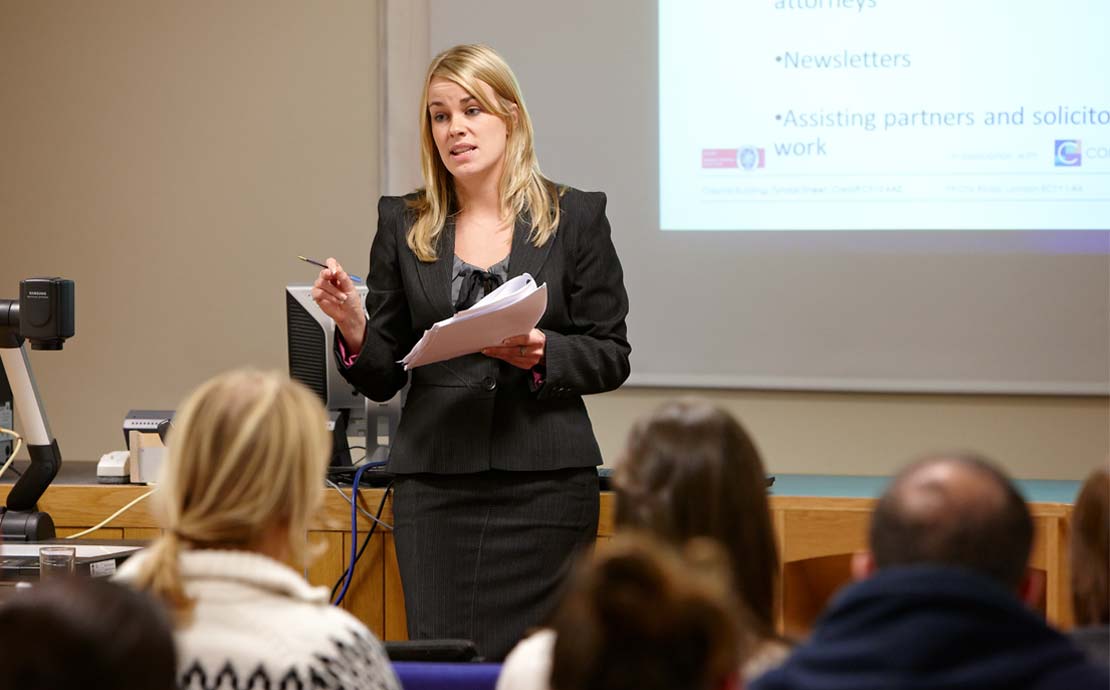
On 15 March, Dr Caddell provided a briefing paper at the Senedd Building in Cardiff, at the invitation of Mr Andrew Davies AM, the Welsh Assembly member for Swansea West. Every year, a small number of academics from Swansea University are invited to deliver briefing papers at the Assembly, based on research that has significant implications for Welsh affairs. Dr Caddell delivered a briefing entitled, “The Welsh Marine Zone: Developments and Challenges under the Marine and Coastal Access Act 2009”. The paper provided a full outline of the key powers that have been transferred to Wales in recent years under the devolution settlement and identified a number of challenges ahead for the Welsh Ministers as they seek to implement a network of Marine Conservation Zones under the 2009 Act. The event was attended by members of the Welsh Assembly, key environmental NGOs, marine renewable energy interests and members of the legal profession.
On 17 March, Dr Caddell was invited to present a paper at a conference convened by Mr Greg Jones, QC at King’s College London. The Conference, entitled “The Habitats Directive: A Developer’s Obstacle Course”, was held in memory of the Rt. Hon. Lord Kingsland QC. This highly successful event examined a number of issues related to the implementation of the EU Habitats Directive and its network of Special Areas of Conservation. Dr Caddell was invited to discuss the marine implications of the Habitats Directive, alongside an impressive group of leading speakers, with the key closing address given by the Rt. Hon. Lord Justice Carnworth.